
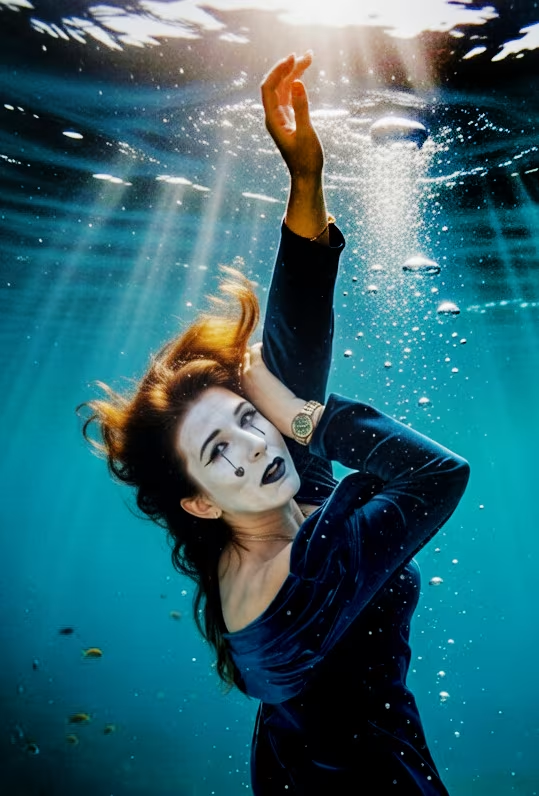

- Your new single “Something Real” introduces listeners to TroubleChutes, a creative project that has been developing over many years. What was the original idea that started this journey, and how has the vision evolved over time?
The original idea grew out of a fortuitous introduction to William Morris through our children’s school. He was also a composer, so some of the other parents thought we might have something in common. At the same time, teachers were describing increasingly difficult friendship dynamics within their classes, and we wondered whether writing a song around those themes that we could offer to our children’s school in the form of a class workshop might give children a different way of exploring those experiences together.
It felt like a natural collaboration. I already had many years of experience writing songs for and with children during my time at Kids Company, where I’d seen first-hand how music and performance could become both a powerful bonding experience and a safe way for children to identify and express their feelings. William came from a background of writing musicals for youth theatre, and when we had written not one but three songs in remarkably quick succession, we volunteered to run a series of workshops at the school.
One of the first songs we wrote was My Shoes. We divided the class into groups, asking each to sing about the same situation from the opposite perspective before bringing everyone back together for the final chorus. Another song, Jealous Friend, received immediate knowing glances. Discussing the lyrics before performing them meant that, rather than simply singing the songs, the children were already embodying the ideas behind them.
The moment we realised something more profound was happening was when the headteacher walked into the hall to find the child whom everyone regarded as the ‘tough guy’ initiating a group hug. It felt like one of those Bugsy Malone moments where rival gangs suddenly lay down their weapons to sing together. Afterwards, teachers and parents told us the children couldn’t stop singing the songs in the playground and at home and, more importantly, that key relationships within the classes had noticeably shifted.
We called the project TroubleChutes as a play on the word troubleshooting. It captured the idea that difficulties can be navigated and moved through rather than simply endured, and changing “shoot” to “chute” made it feel more playful and child-friendly, conjuring up the image of a children’s slide. The name also carried another layer of meaning, evoking a parachute from high above, from which people could look down on life’s challenges from a different perspective. Later, when I came to develop the visual identity with my publisher, Karnac Books, I chose the parachute for the logo because it best captured its pace and sense of freedom.
Over the years, that original idea has grown into something far bigger than either of us imagined. What began as a handful of songs has evolved into an integrated creative framework combining music, illustration, education and emotional literacy, continually reinforcing what experience has shown me: that songs can be powerful openers, enablers and facilitators for identifying, accessing and expressing emotion, and for developing empathy and connection with one another.
- You have described TroubleChutes as a meeting point between music, storytelling, illustration, education and emotional literacy. What inspired you to create a project that reaches beyond the traditional format of an album or single?
Years of working with children through music showed me that the most meaningful moments didn’t only come from playing a song. They happened when children interacted with it, and with me, reflected on the lyrics, sang together and gradually found connections with their own experiences. I wanted to recreate those conditions in a way that no longer depended on my being present, allowing the music to become part of a much richer process of relationship, conversation and discovery, helping the songs fulfil their greatest potential.
Throughout my work at Kids Company, I was given the freedom to experiment, allowing each child’s natural inclinations to guide the process. Over time, I became increasingly aware of the many different ways children engage with the world, and of their differing strengths, preferences and sensitivities. That awareness shaped not only what I introduced, but how I introduced it.
For example, giving a child a creative activity such as drawing or dancing often made them more receptive to lyrics that might otherwise have felt difficult to absorb. Integrating other forms of creative expression to support emotional regulation became all the more important when using songs that brought emotions to the surface.
While music has an almost universal ability to reach children emotionally, providing illustrations, classroom resources and guided discussions felt equally important—not as a diversion or an expansion for its own sake, but as a way of facilitating and deepening the experience of the music itself.
Finding a publishing home with Karnac Books became another important turning point. Publisher Kate Pearce encouraged me to do something I’d never really attempted before: to put into words the intuitive process I’d developed over many years of working with children. She challenged me to explain every stage, from how I introduced a song to how I responded if difficult emotions emerged, and why flexibility, trust and attunement mattered more than following a rigid script. The intention was to transform years of instinctive practice into a framework that teachers could effectively use.
Around the same time, Camila Batmanghelidjh invited me to bring the developing TroubleChutes approach into her post-pandemic nurture programme at Oasis Academy Johanna (South Bank Primary) in central London. Working with children experiencing high levels of anxiety, and being able to pilot the new resource in real classrooms, helped refine it even further and confirmed that the relational process itself was just as important as the songs themselves.
TroubleChutes grew beyond the traditional format of an album because I was naturally following the way I had organically used the songs with children—not in isolation, but as part of a wider process of engagement. That isn’t to say the songs don’t stand on their own. There are times when simply listening to the music is exactly what a child needs. By developing TroubleChutes as a complete resource, though, I wanted teachers to have a range of possibilities, enabling them to respond flexibly to each child’s individual needs, whether that meant listening quietly, singing together, drawing, reflecting or opening up a conversation.
- “Something Real” explores the relationship between fantasy and reality. What drew you to this theme, and why do you think imagination is such an important part of emotional understanding?
Interestingly, while we rightly celebrate the importance of imagination in childhood, we talk much less about how some children can become overwhelmed by its apparent limitlessness if it isn’t balanced with a secure sense of reality. My first conscious connection to this theme came from something my daughter’s nursery teacher said many years ago. She explained that for some children, particularly those with vivid imaginations, it can be helpful to balance fantasy with non-fiction and real facts about the world. It was an astute observation that stayed with me and I hadn’t heard anyone express that idea quite so directly before.
I realised I had instinctively been doing something similar through the books I chose to read with my daughter, a passion carried over from my own childhood. We both adored Russell Hoban’s Frances stories. Although they were fictional, they dealt with very real childhood experiences—fear of the dark, sibling rivalry, picky eating and the everyday emotional challenges that children encounter. Frances would often sing little songs to herself that revealed her inner thoughts in remarkably insightful ways. Those books never escaped reality through fantasy; they used imagination to help children understand reality.
That distinction felt important. Children encounter the disappointments of reality many times every day. They can’t have another sweet, they have to leave the playground, a friend moves away or something simply doesn’t go as they hoped.
A parent saying, “Wouldn’t it be wonderful if there really were a land where every day was the weekend?” is acknowledging the child’s emotional reality rather than dismissing it. Meeting the child with greater compassion through fantasy in turn helps them return to reality with a little more perspective.
Children have extraordinary imaginative capacities, but we can be at risk of unintentionally exploiting them if we don’t also help them feel grounded. Something Real is written from the perspective of someone who has lost their way and is searching for a path back to what feels authentic and real. That felt like the perfect place to begin TroubleChutes, because before we can explore ourselves and the world around us, we need to have a safe base within ourselves from which to do so.
- The project encourages children to explore feelings through curiosity rather than instruction. How did you approach creating music that supports emotional development while still allowing listeners the freedom to interpret it in their own way?
I’ve always believed that you can offer insight without being prescriptive. Shakespeare’s plays are full of profound observations about human nature, yet we don’t leave the theatre feeling we’ve been told what to think. Instead, we’re invited to recognise something of ourselves or others in the characters and decide what resonates.
I approach songwriting from the perspective of a particular character, observation, or emotional experience and offer it not as gospel but as food for thought. Some children will recognise themselves immediately and begin talking about their own experiences. Others may disagree completely and have examples from their own life or observations about why. Both responses are valuable because they encourage reflection. They’re making meaning for themselves rather than having it handed to them.
That’s one of the reasons discussion has always been such an important part of TroubleChutes. The music and lyrics create enough emotional resonance for children to explore ideas together, but they leave room for multiple interpretations.
Emotional development is about creating the conditions in which children feel safe enough to discover and think through their own answers.
- Your songwriting has always been influenced by psychology, philosophy and storytelling. How do these different worlds come together when you begin writing a song?
Luckily, it’s not something I have to consciously plan or think about. Sometimes I already have a feeling that I want to express, and the starting point is finding a sequence of chords that captures it. At other times, I don’t yet know exactly what I’m feeling, and it’s only through playing and exploring different chords that the feeling becomes clearer. In either case, the unconscious lyrics that begin to emerge as I play, gradually reveal what the song is really about.
Not all of those early lyrics will make sense, but there is usually a particular word, phrase or image that captures the emotional essence of the song. My job is to be like a dreamcatcher, catching the threads before they disappear. It’s really from that point onwards that my rational mind becomes more involved. I begin shaping and structuring the rest of the song around that initial spark, almost becoming the editor of the deeper inspiration that first emerged. I don’t really think of those influences as separate because they’ve all been intertwined throughout my life. Everything I’ve experienced throughout it, together with everything I’m still experiencing, has the potential to end up in the music.
Q6. Was there a particular song, artist or creative work from your childhood that first showed you the possibilities of combining music with storytelling and visual imagination?
When I was a child I adored Really Rosie, the collaboration between Carole King and Maurice Sendak. I’d never seen or heard anything quite like it before and, even now, I can’t think of anything truly equivalent. I loved every aspect of it. The miniature Nutshell Library books were beautifully designed, with Maurice Sendak’s illustrations on one side and Carole King’s lyrics on the other. They were small enough to carry around with me, so I would learn the songs and sing them over and over again.
Watching the animation brought those same characters I’d already fallen in love with magically to life. Many weekend mornings were spent watching the full-length film on repeat. My older brother and my parents loved the songs too, so it became something we could all enjoy together as a family. I shared them with my friends and we would perform them both at home for our parents and later at school assemblies.
Really Rosie was the first truly multi-dimensional creative work I experienced, with different art forms all enriching one another. I didn’t think of it in those terms at the time of course, yet I remember how activating I found it, and how far and wide I shared the experience.
Q7. You have spoken about the influence of Carole King and Maurice Sendak’s Really Rosie. What lessons did you take from that work, and how did you hope to create something that reflects a similar sense of wonder for a new generation?
One of the most important lessons I took from Really Rosie was that songs can become the starting point for meaningful conversations. I vividly remember long discussions with my dad about the moral of the story in Pierre, a boy who seemed not to care about anything. It brilliantly observed something many parents recognise—that children and teenagers can sometimes appear indifferent to almost everything. It’s only when Pierre comes face to face with a lion who says, “If you don’t care, then I will eat you,” that he suddenly reconnects with the value of his own life and the people who love him.
These were serious themes, recognising children’s anger with their parents, but they were delivered with the lightest of touches, with imagination and flair. It helped that the melodies were also infectious, the words full of rhyme and rhythm. There was an insightful message within, but it had to be found, not told. These songs taught me that children are capable of engaging with complex emotions and ideas when they’re presented with honesty, warmth and imagination rather than being simplified or avoided altogether.
The music reflected that philosophy too. These weren’t songs that spoke down to children. They were performed by outstanding musicians at the top of their game, with all the richness, energy and musicianship you would expect from classic hits written for adults. It showed in practice something I’ve believed ever since—that creating work for children never means lowering the artistic standard, and that adults can enjoy it just as deeply.
I’ve also reflected back on how parental it felt to be sung to about subjects that matter. We all recognise the comforting power of lullabies for young children, but somehow that idea largely disappears as children grow older. To me, the songs in Really Rosie almost functioned like lullabies for older children, offering comfort through words as well as music.
With TroubleChutes, I wanted to create something that offered children that same sense of containment, alongside the excitement, energy and joy that music can bring. Just as importantly, I wanted the songs to become access points for conversations within families and classrooms, in the same way that Really Rosie created conversations within mine.
Q8. “Something Real” features collaborations with musicians including Henry Thomas, Paul Hirsh, Martyn Barker, Tony Qunta and Clifford Slapper, alongside production input from Stuart Epps. How did these collaborations shape the final sound and emotional atmosphere of the track?
One of the greatest strengths of this project has been that the musicians weren’t only exceptional performers; they also all had experience teaching young people. That combination meant everyone understood both the musical ambition of the project and the audience it was ultimately created for.
Many of us had already worked closely together on Near Life Experience, so there was a deep sense of trust and musical understanding before we even began. That meant everyone could concentrate on serving the song rather than getting to know how we each operate musically or as people. Henry Thomas was central to holding all of those different elements together, while Martyn Barker, Tony Qunta, Clifford Slapper and Paul Hirsh each brought something distinctive that helped create the emotional landscape of the recording.
Although the recording process began under the unusual circumstances of the pandemic, I think that shared experience also deepened the emotional atmosphere of the music. We were all living through uncertainty and separation while creating a song about searching for something real.
Whilst the song itself was written with William Morris pre-pandemic, the emotional world we were all living through at the time certainly found its authentic expression in this pandemic recording. In usual times we would have met in a rehearsal room and I would have said what the song was about in a couple of sentences. In this instance, something else went in our favour. I wrote emails explaining the meaning of the song and the musical vision I had for it. Similarly, Henry wrote detailed emails on his production vision before each musician recorded their part. This meant that far more time had been spent assimilating the messaging and musical vision before each musician began work on their part. I think this all contributed to the final sound.
When we later had the opportunity to revisit the recordings with Stuart Epps, his fresh ears and wealth of experience gave us the opportunity to build on the song’s earliest foundations, overcoming many of the limitations imposed by the pandemic recording process, whilst retaining all the original energy and emotion that mattered most.
Q9. Stuart Epps has worked with some of the most influential artists in music history. What was it like bringing him into the TroubleChutes world, and what did his experience add to the recording process?
By the time Stuart became involved, post-pandemic, the heart of the song was already there. He immediately recognised what made it special and indicated what more could be done to help us realise its full potential.
Spotting production elements that had been limited because of the pandemic recording situation, he brought in his long-term collaborator Paul Hirsh, to bridge the gap. His additional piano and string textures became an important part of that final stage, helping the arrangement feel even more expansive while remaining emotionally grounded.
Re-recording vocals with Stuart was a particularly memorable experience. His encouraging attitude towards me, my voice and the song immediately put me at ease and created an exciting sense of possibility. He made me feel that I had a right to be there, and his confidence in both me and the song influenced my whole experience of the recording process.
One of the things I admired most was that, despite Stuart’s extraordinary career, there was never any sense that he viewed me any differently from any of the major artists he has worked with. In fact, he drew direct parallels which got us into riveting conversations about the songwriting and recording processes of artists I had long admired. When I was apologetic about spending a long time on the vocal edits, he would smile knowingly and tell me Elton John spent way longer!
- You have experienced many different chapters as an artist, including your work with Near Life Experience. How does “Something Real” connect with your earlier musical journey, and where does it represent a new beginning?
Although Something Real became the first public introduction to TroubleChutes, its roots stretch across different chapters of my life. The earliest foundations go right back to my work with children at Kids Company. It was there, working with some of the country’s most vulnerable children, many of whom had little or no security in their lives, that I truly realised the transformative power of music. A couple of the songs within TroubleChutes were first written during that period, and I already knew what they meant to the children because I’d seen the impact they had first-hand.
That gave me a conviction about recording them that you don’t normally have. Usually, you write and record a song first, and only afterwards discover whether it resonates with people. With these songs, it was the other way around. I’d already witnessed their emotional impact years before they were professionally recorded, and I also carried with me the meanings the children themselves had found within them. I wanted to do justice to those experiences.
When Henry Thomas and I were discussing which songs we should record for TroubleChutes, he would go through all the songs I played to him making notes on structure, melody, impact, lyrics and giving them marks. Something Real was the one he immediately felt was the most complete in every sense. That feeling stayed with both of us throughout the recording process and went on to influence our decision to release it as the first single and public introduction to the project.
There were also some wonderful moments of serendipity along the way that seemed to mark a new chapter in the song’s journey. Looking back at the original email I had sent the band explaining my vision for Something Real, I’d referenced some of Elton John’s great early classics, including Your Song, Tiny Dancer and Goodbye Yellow Brick Road. You can imagine my delight when Stuart Epps—who had spent years working and touring with Elton John—contacted me on Facebook after hearing Like an Angel. That became the final impetus to set a new recording date! Equally delightfully, when I later told Martyn Barker how much TroubleChutes had been inspired by Really Rosie, he revealed that he’d previously played with Andy Newmark, who had been the drummer on the original Really Rosie recording! None of those coincidences changed the music, of course, but they certainly added to the feeling that the project had found exactly the right people at exactly the right time.
Something Real represents a new beginning because it’s the first time I’ve publicly brought together my songwriting, psychology and experience of working with children into something that can be used by others. As I get older, I become increasingly aware of what I want to leave behind. I can only work directly with a handful of schools at any one time, but through TroubleChutes many more schools could potentially benefit. That makes this feel like a particularly meaningful new chapter in my musical journey.
- The TroubleChutes project moved into schools through an emotional literacy programme. What did you learn from seeing children interact with the music and stories in an educational environment?
When bringing TroubleChutes to the Oasis Nurture programme one of the things that was immediately apparent was how the children were bursting with thoughts and feelings that really needed a space and an outlet to be processed. There was a feeling that they had taken in more than they were developmentally equipped to process at any one time, so play—in whatever form or medium—that allowed them to follow their instincts without having to follow structure or rules became essential.
I also learned how, in the understandable desire to preserve children’s innocence, adults can sometimes avoid difficult subjects. What they needed in these instances wasn’t simpler ideas, but safe, imaginative ways of approaching what was already there.
Working with the children at Oasis reaffirmed something I’d seen time and again throughout my earlier work: children will find their own meaning within a song without being prompted. I’d often begin by asking what they thought the lyrics meant, and I was continually amazed by the different interpretations they offered.
In one song Singing an Ocean, there are the lyrics “Music is a place, where I know I’ll find my space”. One child thought ‘the space’ was the physical room we were in together; another, when asked where the space was, pointed to their heart.
A child would always notice something I’d never consciously intended when writing the song, yet their interpretation would make complete emotional sense. Those moments reinforced my thinking that songs can offer insight without closing down interpretation. They leave room for children to discover meanings that neither they nor I may have anticipated.
I also had to rethink the structure I had originally planned. In my mind, I envisioned that the children would listen to the whole song first, then discuss its meaning, then learn it. When working with children in person, I quickly realised those rigid structures didn’t work. Some children were too dysregulated to listen to a song all the way through from the beginning. I needed to go back to the drawing board and rethink the guidance so that it reflected the flexibility children actually needed. When I later came to write the guidance for teachers, I wanted them to know that I trusted their professional judgement too, something I felt had become less available to them in recent years. Rather than prescribing a fixed order, I encouraged them to choose the songs and activities according to what they sensed the children needed on any given day.
After seeing the immense pressures teachers are under to deliver information, and how children who are struggling can be much harder to teach, I began to understand the difficult feedback loop that can develop between the two. Over time, it was wonderful to see the teachers gradually develop trust in us. There were nurture practitioners working in different rooms across the school through art, games and music. It took time, but as the positive impact on the children gradually fed back into the classroom, we came to be seen not as an interference, but as a support.
The introduction of the TroubleChutes illustrations alongside the songs was an exciting new development. I saw how the pictures created many more questions and also helped them to think about the words in the songs differently, making new connections. In the song Planet Red, one child asked about the clothing of the boy on the rocket, wondering whether he would be warm enough in space. The illustration was deepening their ability to empathise with the character and imagine the scenario.
The most important lesson was witnessing children’s emotional growth when they were listened to consistently over time. Confidence grew, relationships shifted and children discovered strengths they didn’t know they possessed. Teachers saw improvements in the classroom, and this in turn created a positive feedback loop, improving the atmosphere for everyone. For me, that has always been the premise of TroubleChutes. The resource becomes something to bond over, and it is those trusting relationships that so often make a lasting difference.
- The TroubleChutes project has expanded into television, animation, publishing and visual storytelling. How do you maintain a clear artistic identity while allowing the project to grow across so many different creative formats?
One of the beauties of hindsight is that you can look back and see the patterns running through everything you’ve done in a way that’s impossible when you’re living life forwards. Looking back now, I can see that whatever form my work has taken, there has always been the same underlying desire: to explore what it means to be human and to share whatever understanding I’ve gained along the way. I’ve always tried to live in a way that makes the best use of whatever understanding I have at the time, while remaining open to re-evaluating it through age, experience and new discoveries.
One unexpected aspect of releasing music publicly has been the opportunity to reflect on what journalists and reviewers have said about my work. In the early years, they quite naturally drew comparisons with other artists to help place my music in context. While I was honoured that many of those comparisons were with artists I greatly admire, it became increasingly rewarding to see reviews begin to focus on the qualities that were uniquely my own.
Moving into different creative mediums has been an opportunity to discover how the same underlying principles can be expressed through different forms. Whether we’re arranging a song, editing a film, reviewing an illustration or refining a script, Henry Thomas and I are always returning to the same question: does this serve the emotional truth of the story? If something doesn’t feel right to either of us, we stop until we understand why. Developing that way of working through music first made it much easier to apply the same principles to television, publishing and visual storytelling.
We’ve also been incredibly fortunate to collaborate with people who care about the project. Conversations with the award-winning animator and music video director Sam Chegini have deepened our understanding of visual storytelling, while the editorial process with Karnac Books helped ensure the illustrations remained true to the emotional world of TroubleChutes. Those collaborations provided valuable additional input and expertise on how to express the same underlying values through different creative languages.
My artistic identity, always a work in progress, has gradually revealed itself to me through the relationships, conversations and values that have aligned during the process of creating.
- In today’s music landscape, where releases often focus on speed and instant impact, TroubleChutes feels like a long-form artistic project. What does taking time to develop something meaningful mean to you?
One of the difficulties with creating to satisfy algorithms or to avoid keeping an audience waiting is that those pressures can gradually become the driving force behind what you’re making rather than the creative process itself. For me, the work has always dictated its own pace.
I’ve known songwriters who panic if they sit at the piano and nothing arrives. I’ve never felt that way. If I sit down and nothing emerges, I trust that the timing isn’t quite right. Emotional processing can’t be hurried, and I’ve learned that when something is ready to be written, it usually makes itself known. Waiting has never felt like doing nothing; it has always been part of the creative process.
The practical realities of making music have also changed enormously. In the past, artists supported by record companies could spend weeks in a recording studio refining every detail. Independent artists rarely have that luxury today. Henry Thomas and I recognised early on that if we couldn’t compete financially, we would have to compete through care, preparation and attention to detail. Much of that work happened outside the studio, spending countless hours refining arrangements, discussing ideas and making sure every decision genuinely served the songs.
That same philosophy has extended to every other aspect of the project. Some of the music videos I created with Sam Chegini took far longer than any of us would have wished because they were being made during periods of blackouts and disrupted communication. Earlier in my career, working with the legendary visual artist Storm Thorgerson taught me something similar. He never rushed the creative process simply to meet a deadline; the work was finished when it was ready. While that approach can be challenging when release schedules and promotional campaigns are involved, I’ve not yet regretted choosing artistic integrity over speed.
I don’t think it’s helpful to measure meaningful work by how quickly it reaches the world. There may come a time when time itself becomes a higher priority, but for now I’ve had the luxury of letting the work itself be the measure.
- After decades of songwriting, what continues to excite you about creating music? Has your relationship with the creative process changed as your life and experiences have evolved?
In many ways, I don’t think it has changed very much at all. My life and experiences have, of course, changed the content of my writing, but the creative process itself remains remarkably familiar. Perhaps that’s why it feels so natural, yet continues to excite me. I never know what experiences are to come and with that what new songs! I also take great comfort in knowing that music is always there beside me as a way of making sense of whatever life brings.
One of the wonderful things about songwriting is that there is no age limit. As long as I’m still curious about life and able to reflect on my experiences, I imagine music will continue to play an important role.
It always tickled me that while most people kept diaries to preserve a record of their thoughts, songwriters could make actual records on vinyl that preserved them too. Since releasing my music into the world, I’ve found it fascinating both to know and not know what people make of the songs. Music remains full of mystery!
- Looking ahead, what do you hope people discover when they enter the world of TroubleChutes — and what would you like “Something Real” to leave listeners feeling?
If people enter the world of TroubleChutes through Something Real, I hope they discover—or perhaps rediscover—the power and mystery of music as a way of making meaning from our lives.
I hope people enjoy the music and the visual world that surrounds it. If Something Real encourages someone to reflect on their own relationship between fantasy and reality, or supports them in exploring their own feelings, then sharing it will already have served its purpose.
If teachers happen to discover the project, I hope they’ll feel curious enough to explore the TroubleChutes website and get in touch to find out more. Seeing children respond so honestly and imaginatively has been such a privilege and I’d love other schools to experience that too. For those who watch the video, I hope they’re moved by the authenticity of the children’s responses and performances.
Openness, curiosity and a sense of wonder are not reserved for children alone. If the music brings anyone closer to that way of seeing again, then it will have served a double purpose: not only helping children grow, but helping adults remember.




