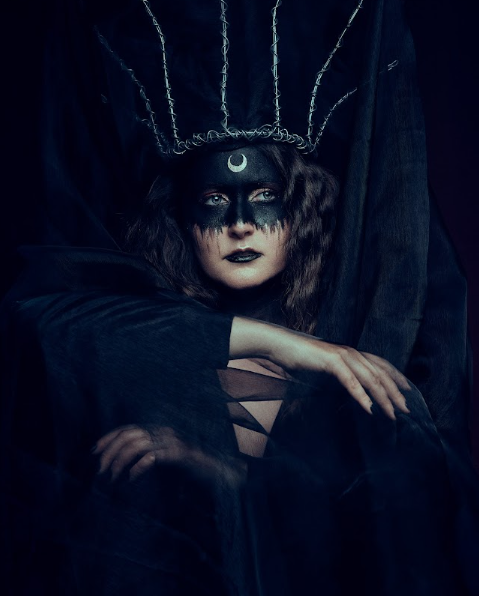

Mané’s The Goddess in the Room arrives as an immersive and emotionally rich body of work that pushes the boundaries of alternative pop. Blending atmospheric electronics with ritualistic percussion and deeply personal storytelling, the Swiss singer-songwriter introduces listeners to her self-described world of “shamanic pop” with remarkable confidence. At the heart of the project lies transformation. Across nine tracks, Mané guides listeners through a narrative of self-discovery, touching on themes of queerness, feminism, ancestral healing, spirituality, and mental wellness. Rather than approaching these ideas as abstract concepts, she grounds them in songs that feel deeply lived-in and emotionally authentic. The production is one of the album’s greatest strengths. Haunting synth textures and organic rhythmic elements create an expansive soundscape that consistently feels cinematic. Tracks like “perles de sang” and “ALIGNED” showcase Mané’s ability to balance intimacy with grandeur, creating moments that feel equally suited for solitary reflection and communal celebration. What stands out most is the project’s sense of purpose. Every sonic choice, lyrical motif, and atmospheric detail contributes to a larger vision. The album functions not only as a collection of songs but as an invitation for listeners to reconnect with their intuition and embrace their individuality. The Goddess in the Room represents a significant artistic statement from Mané. It’s a project that feels both timely and timeless, offering a powerful reminder that music can still serve as a catalyst for healing, connection, and personal growth.
Your new album The Goddess in the Room feels deeply personal while also carrying universal themes. What inspired you to tell this particular story now?
The Goddess in the Room is about reclaiming your inner power, and this has been a long journey I’ve been on and still am. It took me a few years to write this album, and the themes kept coming along, so it’s all a part of how I feel like expressing myself about women’s rights, being queer, etc. This is the result of self-discovery and trying to embrace myself for who I am, and I’m really happy to finally be able to share it.
The concept of “The Goddess” sits at the centre of the record. Who is she, and what does she represent to you?
She is a part of myself – the one deep inside who always knew who she was, who has always been aware of her inner power and who trusts her intuition – and I think she is present in each and every one of us. She’s a reminder that we don’t need to look for validation on the outside and that everything is already within ourselves.
Looking back to when you first started making music, what were some of the defining experiences that shaped your artistic identity?
Definitely moving to London and performing there in my early twenties! It has taught me so much. Back then I wanted to make commercial pop music, and I was super inspired by Lady Gaga. Seeing her live inspired me to write songs at the piano and also massively influenced me visually at the time. Also, later on, travelling to L.A. and Paris to work with some producers shaped my previous EP, as I was exploring my pop sound.
Your work blends pop, spirituality, activism, and storytelling in a way that feels quite unique. Was there a specific moment when those different elements began to merge into one artistic vision?
Thank you, I love this question! There wasn’t one specific moment, but definitely a period of time. Around 2017/2018 I had a burnout, and I tried many different things to recover, which definitely brought me to explore my own spirituality. That’s when I got introduced to the shamanic drum, and also saw Eivør on stage, which really inspired me to blend the drum with my pop music. At the same time, the Me Too movement emerged and made me realize so many things about the world and my own life—that’s when I started educating myself about feminism and started writing songs about witches and women’s rights. So I guess that was a gradual process that made it all merge together at some point.
You’ve described your music as “shamanic pop.” What does that term mean to you, and how has that sound evolved throughout the creation of this album?
For me, it’s a blend between pop influenced by AURORA, Billie Eilish, etc. and some rawer sounds, which are mostly coming from intuitive vocals and other organic percussion, including the shamanic drum. I was deeply influenced by Eivør, who also plays the shamanic drum on stage and blends it with her music. I think it’s also about another dimension opening up on stage when I play the drum, sometimes putting me into a trance. It has evolved throughout the creation of the album as we were trying to find the right sounds and realized what made my music actually more mystical was the intuitive vocals and the way I could include these in the recordings while keeping a pop sound in the production.
Several songs touch on themes of bodily autonomy, feminism, and queer identity. How important is it for you to use your platform to explore these conversations?
It is vital to me. Men in many countries are stripping women of their rights on a daily basis and it keeps getting worse. The same thing is happening for LGBTQ+ people around the world, and I think it’s so important to be able to talk about these topics whenever we get the chance. It’s so important to raise awareness and use our voices, because some of us are more privileged than others to do so. If I was living in certain countries right now, as a queer woman I would not have the right to speak, and I’d probably even be tortured or sentenced to death. So it’s crucial that we use our voices for the ones being silenced right now.
The album moves through moments of vulnerability, resistance, celebration, and healing. Was there a particular emotional thread you wanted listeners to follow throughout the tracklist?
Yes, and I’m so glad you’re asking that question! To me, this tracklist is a full-circle journey and depicts the quest of finding our inner power back. It starts by remembering who we are with The Goddess in the Room and moves on to reclaiming our bodies with Perles de sang. It then swirls between celebrating our queerness and uniqueness with Sappho, and honoring our ancestors, as well as burning down patriarchy on the way, and finally coming back to oneself, realizing that our need to be seen can be fulfilled by ourselves when we look at all the parts of our soul and embrace them. It goes through so many emotional stages, which are all part of this empowering journey, and it ends with feeling at peace, with ALIGNED. I wrote it to end on this sensation that we are HOME in our bodies and souls.
Can you tell us about the role of ancestral healing and spirituality within your creative process? How do those practices influence your songwriting and performances?
To me, ancestral healing is about re-connecting to some of my roots (Armenian, Iraqi & Assyrian) and to the women who came before me, in my family, but also in a more general sense—drawing inspiration and strength from their stories. They deeply inspire my songwriting and I feel like their souls and energy are sometimes transcending me—and I hope it resonates with other women’s stories. I see spirituality as such a personal and broad theme—to me it means trusting a higher voice, an inner one, and connecting to something bigger, broader and quite indescribable. So I’d say, to me it’s a complete part of the creative process and of the magic that happens on stage—these moments of grace, where I just feel alive and connected, transcended by pure energy.
You have spoken about experiencing burnout in the past. How did that challenge ultimately reshape your relationship with creativity and success?
Going through multiple burnouts has definitely taught me how to treat myself more gently and also how to set some boundaries. It’s also shown me what matters the most to me, and it’s during that time that I started understanding myself and my high sensitivity better. So it definitely has had an impact on the topics I want to address in my songs. During these times, I’ve also encountered the shamanic drum and learned how to navigate my emotions through intuitive vocals – so it definitely has influenced my whole sound on this album, bringing more organic sounds into pop productions. It has also helped me realize how much pressure I used to put on myself – and although I am still navigating that, I see success differently now. I used to think that if I hadn’t reached certain society’s expectations by a certain age, my life was over. And now, I see success as happiness, enjoying the present moment and small consistent wins.
Which track on The Goddess in the Room was the most difficult to write, and which one came most naturally?
The one that took me a lot of time to write was Moonstones (which is about the Armenian Genocide and an echo to the genocides happening in the world right now) because I kept making changes to the lyrics and I really wanted every metaphor to clearly depict the images I had in mind. The one that came quite easily was actually The Goddess in the Room – the lyrics all came in one go.
Songs like “sappho,” “moonstones,” and “Witches” each explore different facets of empowerment. How do those tracks connect within the larger narrative of the album?
Sappho really is about embracing queer desires, Moonstones is about honoring my people and Witches is also in memory of all the women burnt at the stake, so to me it all encompasses this notion of reclaiming yourself, reclaiming your body and honoring the women before you – which all links to reclaiming your power in my point of view.
You’ve performed everywhere from Montreux Jazz Festival to London’s Southbank Centre and venues across Europe. What have those experiences taught you about connecting with audiences?
It has taught me so much! I used to be extremely scared of what the audience would think, and I still am sometimes, but playing at all these places over the years has given me confidence and now I feel so aligned when I’m on stage – I love connecting with the audience, feeling them vibe to the music, looking them in the eyes – it’s the best feeling in the world.
Your live performances incorporate ritualistic elements and shamanic drumming. How do you approach translating the album’s intimate themes into a live setting?
During my live shows, we’re playing with the same production that’s on the album. I’d say what could make it more intimate on stage is when I speak in between songs and how I create a ritual at the end of the show that translates those themes: I love to make people breathe and sing with me, scream, dance, jump, meditate, and in the end, I put paint on people’s hands as a transformation and liberation ritual.
Community-building appears to be central to your work, whether through your music, podcast, or immersive events. Why is creating those spaces important to you as an artist?
I believe every human being craves being seen and loved. I think that’s part of the reason why we create art, and why we listen to music: to feel something, to feel like we belong somewhere. So, to me, it’s these moments of connection that actually really matter in the end – creating a community where people can celebrate who they are, feel inspired, and feel a sense of belonging in a safe space. I love connecting with people, and in a world where most things are now centered around screens and AI taking over, it’s super important to me to have true “in-the-flesh” meetings. The world is already such a hard place, and we need more care for each other.
As you enter this new chapter with The Goddess in the Room, what does success look like for you—not just professionally, but personally and creatively?
To me, it looks like being consistent with my art and trusting the process. Creatively, it’s about enjoying the creative process and staying in the present moment. Making art that I love. And personally, it’s about this deep feeling of alignment, listening to my intuition and being aligned with what I say, feel and do. Being surrounded by my loved ones and enjoying the small moments of life that matter the most.