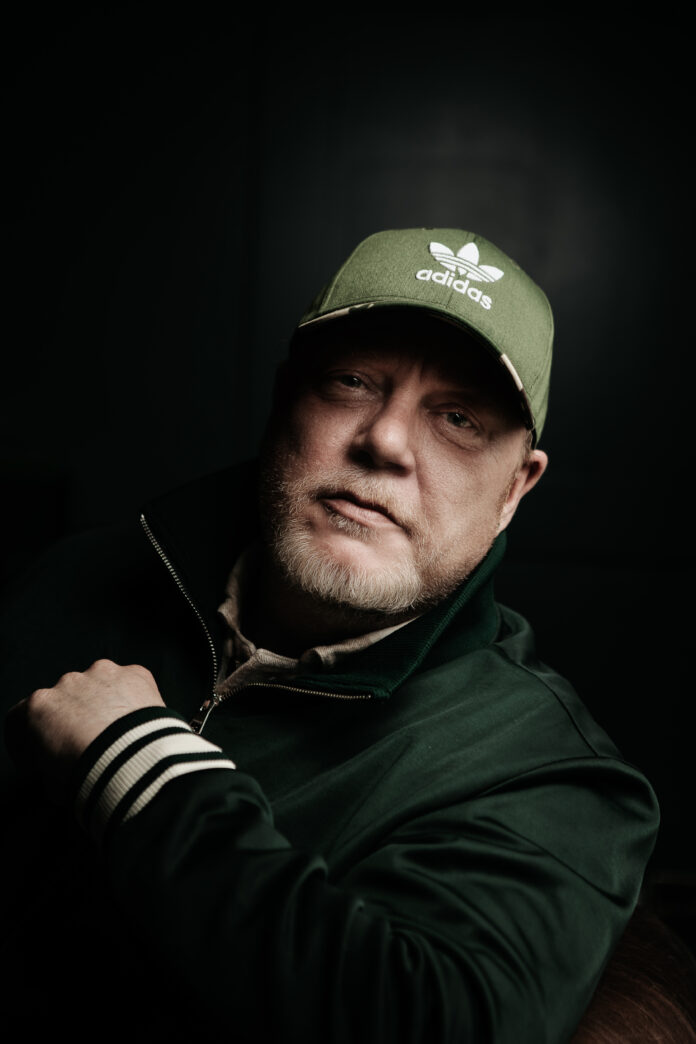

With a career spanning more than three decades, German-born, Ireland-based artist and songwriter Damien Cain has continually evolved without losing sight of emotional honesty at the heart of his music. From underground alternative projects to theatre, film collaborations, and chart success, his work has consistently explored identity, memory, and the spaces where personal stories become universal.
TAGG caught up with Damien Cain to discuss his poignant new single “Caleb”, the unexpected power of collaboration, finding authenticity beyond genre, and how time, distance, and reflection continue to shape both his songwriting and his perspective.
You’ve had a career spanning over three decades across different scenes and identities. How has your definition of “authenticity” in songwriting changed over that time?
When you’re young, you constantly feel the need to prove yourself. You desperately want to belong to a specific scene, but at the same time, you’re trying to be unique enough to stand out. So you fight with genres, your image, and everyone’s expectations.
Over the years, that whole struggle just quieted down. Today, authenticity isn’t about performing darkness, rebellion, or vulnerability to satisfy a certain look or crowd. It’s much simpler: it’s about recognizing the exact moment you actually have something to say … and then saying it without compromising.
An authentic song is the one that still holds up after you strip away all the clever tricks, the heavy production, and the drama. If there’s still a heartbeat left underneath, I trust it.
“Caleb” began as a deeply personal solo memory, but evolved into a duet almost by accident. What did you discover about the song once another voice entered it?
I realized it wasn’t just my story anymore.
Originally, “Caleb” felt incredibly internal, like talking to a ghost, or to an older version of myself that refused to let go. But the moment Jamie Wiltshire added his vocals, the whole vibe shifted. It stopped feeling like a lonely confession and turned into a real conversation.
Memory is rarely as private as we think it is, especially when it comes to love. Two people can carry the exact same past, but experience it in completely different ways. Jamie’s voice brought that second perspective into the track. Suddenly, the sense of loss felt shared.
When Jamie Wiltshire’s vocals reframed the track as a kind of dialogue, did that change the way you understood the memory at the centre of the song?
Absolutely. It shifted the focus from one person brooding over the past to the actual space between two people. Before Jamie came on board, that central memory felt frozen, painful and beautiful, but completely fixed in time. His performance breathed life back into it.
It reminded me that the past isn’t just something we look back on; it’s something we actively live with and renegotiate every day.
That really changed how I view the song. It became less about forcing closure and more about acceptance. Letting go doesn’t mean a memory vanishes. It just means you finally stop trying to rewrite the ending.

You’ve worked across theatre, film-adjacent projects, underground bands, and charting releases. Do you approach a song differently when you know it might live in a commercial space versus a more conceptual one?
I try hard not to think about that when I start writing. You have to protect the initial spark from any kind of strategy. Of course, later down the line, you have to get practical: you look at song structure, radio edits, production choices, and track lengths. I’m not naive. But if your very first question is “Where will this fit?”, the song is already dead in the water.
Conceptual work gives you a wider canvas to play with, while commercial tracks require more discipline and focus. But the emotional benchmark shouldn’t change.
A three-minute radio pop song needs to carry just as much truth as a nine-minute gothic epic. The best songs are the ones that can survive in both worlds.
A lot of your recent work seems more introspective since moving to Ireland. Has that relocation shifted the emotional tone of your writing or just given it more space to surface?
It’s definitely a mix of both.
Moving to Ireland gave me massive distance, from Germany, from past versions of myself, and from a lot of expectations. But more than anything, it gave me silence.
And silence can be dangerous, because eventually, you start hearing your own thoughts a lot clearer.
There’s something about the Irish landscape and culture that inherently understands melancholy without viewing it as a weakness. That did something to me. My writing became much less defensive. I stopped hiding the emotional core of my songs behind layers of poetic armour. The darkness is still there, it just has room to breathe now.
Given your collaborations with figures as varied as Sir Christopher Lee and Wayne Hussey, what draws you to certain voices or collaborators — instinct, contrast, or emotional resonance?
It’s always instinct first.
A voice has to do something to the room the second it starts. It doesn’t need to be technically perfect, but it has to shift the atmosphere. Christopher Lee had that down to a science; it was almost mythological. His voice carried history, weight, and shadow before he even finished a syllable.
Wayne Hussey brought a totally different energy: romantic, poetic, a bit bruised but deeply defiant. And with Jamie Wiltshire, it was a completely different story again: there was this raw tenderness that turned the whole song on its head.
So yes, contrast is great, but emotional resonance is the real deal. I’m always drawn to voices that can pull something out of me that I never could have reached on my own.
You support akt and LGBTQ+ youth facing homelessness. Does that advocacy connect back into the emotional themes of “Caleb”, particularly around memory, identity and letting go?
Yes, though I”m always careful not to weaponize “Caleb” as a mere campaign slogan. The song is deeply personal first and foremost.
But the connection is definitely there. “Caleb” deals with identity, memory, love, and the heavy toll of unresolved pasts. For a lot of LGBTQ+ youth, those aren’t just poetic themes, they are harsh realities tied to family rejection, safety, forced silences, or having to rebuild your life from scratch somewhere else.
I support akt because I’ve seen firsthand, especially in London, how incredibly vulnerable young queer people become simply because the people who were supposed to protect them failed them. That sticks with you. For me, supporting akt is a reminder that queer stories need more than just “visibility”. They need safety, dignity, and real, practical help. If “Caleb” can open up even a small door for that conversation, I’m incredibly grateful.

Make sure you listen to “Caleb”: