
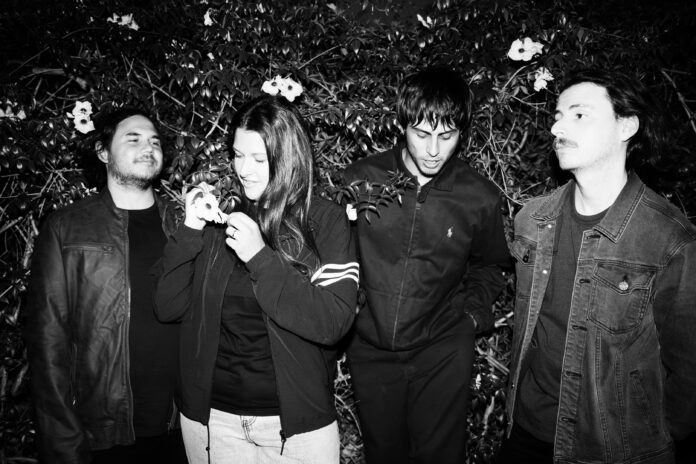
Australian alternative rock outfit Fragile Animals have built a reputation for pairing expansive shoegaze textures with deeply personal songwriting, capturing the tension between ambition, vulnerability, and resilience. Their latest EP, Dead Stop, arrives in the aftermath of a career-defining tour, exploring what happens when long-held dreams suddenly feel within reach—and the anxiety that comes with holding onto them.
TAGG caught up with Fragile Animals to discuss the emotional fallout behind Dead Stop, writing through uncertainty, and why some of their most honest music emerged from a cramped Manchester hotel room between moments of hope and self-doubt.
- Your new EP was written right after touring Tourist, in what you’ve described as both a dream and a breakdown. What changed inside the band when the tour ended and the momentum stopped?
In reality, I think what happened was that for the first time we started to believe that we could build the life in music that we all wanted.
I think that when you’re starting out you have some level of blind belief that you’ll be able to ‘make it’ but it also feels kind of wildly unrealistic at the same time. That underlying disbelief is actually easier to live with than having hope. If you don’t really think something is possible the stakes feel much lower. Once you think something could be within your grasp, you can’t help but fear losing that opportunity.
So, basically making the Tourist record and going on that tour helped us to believe in ourselves in a way we hadn’t before. But then we had to figure out how to stop our own anxieties getting the better of us.
2. At what point during that post-tour period did you realize the material you were writing wasn’t just a continuation of Tourist, but something more fractured or uncertain?
We always seem to end up writing in broken up chunks of time rather than anything continuous. Haha. It sounds quite nice to be able to just let your creatively roll along, but also, having those forced breaks in between does seem to allow the music to evolve a bit from release to release, so maybe it’s a good thing.
So there was a gap of time in between, but more significantly, the headspace for writing Tourist was very different from the mindset we had while writing Dead Stop.
With Tourist, we were feeling really disenchated with the music industry when we wrote it. We were sick to death of the way it all works. You’re constantly told you need to ask permission, and justify yourself as a band. It’s exhausting and demoralising so we kind just thought ‘f*ck it, let’s make a record and find a way to book ourselves some shows on the other side of the world’. So, in a weird way, it was written from quite a positive, or at least determined, mindset.
As you mentioned, Dead Stop was written at the end of our that tour. We felt super proud that we managed to somehow make it happen, and we’d just had the best time. We’d promied each other that we find a way to come back the this year, but we were in debt, had no new music and felt, somewhat ironically, a bit fragile. So it’s not surprising that the record sounds more fractured and uncertain, we certainly were.
3. There’s a moment mentioned where the band is in a hotel in Manchester trying to write and everything starts to unravel. Do you remember what the music sounded like in those early writing sessions. Was it controlled, chaotic or something in between?
Yeah, I remember those two weeks so clearly. We really wanted to make the most of the time we had, and definitely were putting a bit of pressure on ourselves to come up with something. It’s like I was talking about before – we had that whole hope/fear thing running through us, and we knew we needed to make a new record if we wanted to come back to the UK and Europe in 2026.
Musically, we just wanted to write something that we were going to love playing live. Shows are our favourite part of the whole thing, and we love the more weighty and chaotic moments of the set, so we naturally found ourselves leaning into that. Our set up was super basic. We had a laptop and interface for getting music down and I’d literally just demo vocals straight into my laptop mic. Our hotel room that we were working out of was on Church St in Manchester and the windows opened straight out onto the street above some bars. All the vocal demos from that time have the sounds of buses and trains and people walking past all woven through them. It was messy, but it worked. We got a record written. Haha. And those demos are actually so precious to me now because they captured it all.
4. You’ve been gaining international attention—radio play, festivals, awards—but Dead Stop feels like it’s about the cost of that trajectory. At what point does success start to feel physically or emotionally heavy?
Honestly, for us it’s not really that we feel any external weight of success. Like, we’re still a small band from Australia. There aren’t too many people who probably care what we write next. Haha. So, for us the heavyness comes from not wanting someone to take all of this away from us. We work so hard and everything we do has to come from some level of personal sacrafice from each of us in the band. The end goal we have for ourselves requires that we take some pretty significant chances and that comes with stress, guily and self doubt. Walking a line between getting things done, and looking after yourself physically and mentally is very much a work in progress.
5. Shoegaze is often associated with atmosphere and distance, but this EP sounds like it comes from something very immediate and unstable. Did you have to change your approach to sound to match what you were feeling?
I think we’ve always seen ourselves as heavily inspired by shoegaze, but we like so much other music that we’ve never strictly adhered to all the shoegaze sonic conventions. There were probably a few new toys in the mix gear wise, but for this record we wanted something a little heavier sonically and apart from that we’re just always trying to grow as songwriters.
6. The title Dead Stop suggests interruption or collapse, but the record also feels like it’s about continuing anyway. What does “stopping” actually mean to you in this context? Burnout, pause or something more final?
That’s a good question. I always liked the name and felt like it fit the record, but I never really analysed why. I suppose, for me, that whole time period kind of felt jarring. Kind of like driving and you’re cruising for a bit, then you get stuck in traffic, and then you’re moving again but then someone cuts you off. It was a bit like physical and emotional whiplash. Haha. Somehow the name Dead Stop seemed to sit well within that.




