

Yes, training video production is worth it. It covers six stages: discovery and brief, concept development, scripting and storyboarding, production, post-production, and final delivery.
Your team needs to learn something. The question is whether a document, a live session, or a professionally produced training video is the right way to deliver it.
For complex topics, safety training, technical skills, and onboarding at scale, training videos consistently outperform text-based materials. They are watchable, repeatable, and consistent. Every staff member sees exactly the same content, delivered the same way, every time.
But not all training videos work. A video that holds attention, communicates clearly, and delivers measurable learning outcomes is a different exercise from filming someone talking at a camera.
Here’s what professional training video production in Melbourne involves.
Why Training Videos Work Better Than Written Materials
The case for training videos over documents and manuals is not complicated.
People watch videos. They skim text.
A staff handbook can be handed to every new employee. A professionally produced training video will actually be watched. That distinction matters significantly when the content covers safety procedures, compliance requirements, or technical skills.
The specific advantages of video for training:
- Knowledge retention. Research consistently shows that people retain information delivered through video at a significantly higher rate than when delivered through text alone. Combining visuals, movement, and audio engages more of the brain simultaneously.
- Every team member sees identical content. There is no variation based on who delivered the session, the day it was held, or how much time was available.
- Learners can pause, rewind, and revisit key points as many times as they need. This is particularly valuable for detailed material covering technical skills or multi-step processes.
- A single training video can reach ten people or ten thousand. The cost per learner decreases with every additional view.
- Remote training. For organisations with distributed teams across multiple sites, states, or countries, video is the only format that delivers consistent training at scale without requiring travel or repeated live sessions.
Types of Training Videos and When to Use Each
Not all training content requires the same format. The right format depends on your subject matter, your audience, and your learning objectives.
| Video Type | Best For | Key Characteristics |
| Presenter-led video | Policy, culture, leadership messages | A presenter speaks to the camera. Builds a personal connection. Works well for leadership development and organisational values. |
| Screen capture/tutorial | Software training, systems onboarding | Records a screen with voice-over narration. Highly practical for step-by-step technical skills instruction. |
| Animated explainers | Complex topics, process overviews, compliance | Animation brings abstract concepts to life. No real people required. Works well for educational content with regulatory detail. |
| Safety videos | Workplace health and safety, safety training | Demonstrates procedures and hazards clearly. Can combine presenter, animation, and on-site filming. |
| Scenario-based video | Soft skills, customer service, customer education | Dramatised scenarios show correct and incorrect behaviour. Highly effective for interpersonal training. |
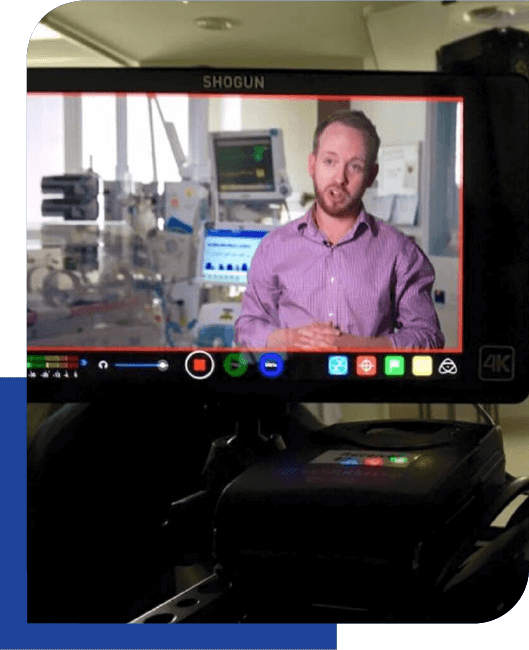
| Documentary-style | Case studies, aged care, healthcare | Real people, real environments. Builds credibility and relatability for sensitive or complex topics. |
Training Video Production Process: From Brief to Final Product
Here is what a professional production runs through.
Phase 1: Discovery and Brief
The production team meets with your subject matter experts. Together, they define the training objectives, target audience, existing training programs, and any compliance or regulatory requirements the content must meet. This stage also covers format preferences, tone, approximate length, and where the content will live.
A strong brief means the team can hit the ground running from day one.
Phase 2: Concept Development
This stage translates your learning objectives into a creative approach. The team decides on format, visual tone, and whether the video will use real people, animation, or both. They also confirm whether filming will happen on site, in a studio, or through animated explainers and screen recordings.
Concept development produces a treatment document. You need to approve it before scripting begins. Changes at this stage are inexpensive. Changes after production has started are not.
Phase 3: Scripting and Storyboarding
The script is written to match the training objectives and the approved creative approach. For safety videos and compliance content, subject matter experts and legal or compliance stakeholders review the script before it is finalised. For animated content, a storyboard is produced alongside the script. This shows how the visuals and narration work together before a single frame is produced.
Phase 4: Production
Production covers filming, animation, and recording. For on-location work, the production team travels to your site, whether that is Melbourne, regional Victoria, or elsewhere in Australia. For studio-based content, the team manages talent, set, and all technical requirements in-house.
Phase 5: Post Production
Post production covers editing, colour grading, motion graphics, voice-over recording, music, and sound design. For educational video production, this stage also includes captions and accessibility features. Subtitles and closed captions are especially important for content inside a learning management system.
Phase 6: Review and Final Delivery
You’ll have to review a draft cut and provide consolidated feedback. A professional video production company typically includes two to three rounds of revisions. The final product is then delivered in the formats your platforms require. It can be MP4 for a learning management system, broadcast-ready files, or compressed versions for a website or YouTube.
What Makes Dream Engine Different
Dream Engine is a Melbourne-based video production company with deep experience producing training and educational videos across healthcare, aged care, corporate, and safety training contexts. Their work is built on a consistent principle: the production process should serve the learning outcomes, not the other way around.
What sets Dream Engine apart when it comes to training video production in Melbourne:
- In-house production team
- Subject matter expert collaboration
- Full-service capability
- Animation and live-action
- Accessibility and compliance
- Experience in high-stakes industries
FAQs
What is a training video?
A training video is a professionally produced video designed to teach a specific skill, process, or body of knowledge. It can be presenter-led, animated, scenario-based, or screen-recorded. The right format depends on the subject matter and the learning objectives the video needs to meet.
What is the difference between training videos and educational videos?
The terms overlap. Training videos cover workplace content: procedures, compliance, technical skills, and onboarding. Educational videos are a broader term. It includes academic, school, and community learning content. The video production process is similar for both.
How long does a training video project take?
A standard three to five-minute training video takes four to eight weeks. Timeline depends on complexity and how quickly internal approvals are turned around. The scripting stage is where most delays happen.
Do training videos work for remote and distributed teams?
Yes. Video delivers consistent training content without requiring travel or repeated live sessions. Teams across multiple sites, including regional Victoria, interstate, and international, all receive the same training. When hosted through a learning management system, completion can also be tracked and reported.
Parting thoughts
Training video production reduces onboarding time and delivers consistent learning outcomes. It scales training without repeating live sessions.
If you are considering training video production in Melbourne, start with one question: what do you need the viewer to be able to do after watching? Everything else follows from that.


