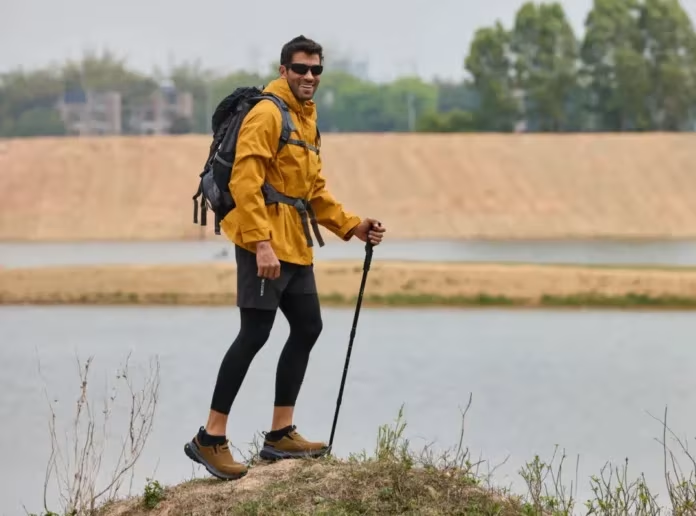
A short coastal walk, a rough section of the Grampians and an overnight trip through wet alpine country may all be called hiking, but they ask very different things of footwear.
That is why the hiking shoes versus hiking boots debate rarely produces a useful universal winner.
Hiking shoes are usually lower, lighter and more flexible. Boots generally provide more coverage, underfoot protection and durability, particularly when the terrain becomes rough or the pack becomes heavier. On a maintained day walk, the extra structure of a substantial boot can be unnecessary. On a rocky, steep or wet multi-day route, a lightweight shoe can leave the foot exposed to more punishment than the walker expected.
Australian bushwalking guidance makes the same distinction. The Bushwalking Manual recommends low- and mid-cut walking shoes for day and track walks, while medium-weight boots are generally preferred for overnight trips or extended journeys with a pack. It also warns against both extremes: footwear that is too light may not adequately protect the foot on rough off-track terrain, while heavy boots can be tiring on good tracks.
The better choice starts with the trail, load, climate and individual foot rather than the traditional assumption that serious hikers must always wear boots.
What Is the Difference Between Hiking Shoes and Hiking Boots?
The most visible difference is height, but the real distinction extends through the whole construction.
Hiking shoes normally sit below the ankle and use lighter combinations of synthetic fabric, mesh, leather or microfibre. Their soles tend to flex more easily, which can make them feel closer to robust trainers than traditional trekking footwear.
Boots generally use a higher upper and more substantial midsole and outsole construction. Depending on the model, they may include firmer toe protection, additional material around the heel, waterproof membranes and greater resistance to twisting or flexing through the middle.
REI describes conventional hiking boots as taller, heavier, more rigid and more durable, while hiking shoes typically trade some protection for lower weight, flexibility and breathability. Some low-cut shoes are capable enough to replace boots entirely for many day hikers.
This is better understood as a spectrum than two rigid categories. A rugged low-cut trekking shoe can be far more substantial than a lightweight day-hiking boot.
Which Is Better for Australian Trails?
For maintained day walks with a light pack, hiking shoes will often be the more practical option. Rougher tracks, heavier loads, extended trips, cold conditions and snow increase the argument for boots.
Australia’s own track-grading system offers a useful way to think about this.
The Australian Walking Track Grading System runs from Grade 1 to Grade 5. Parks Victoria describes Grade 1 tracks as flat and even, while Grade 3 routes may include rough surfaces, many steps and short steep sections. Grade 4 tracks can be long, rough and very steep, with limited directional signage. Grade 5 routes are intended for highly experienced bushwalkers and can be very rough, very steep and unmarked.
Footwear should become more protective as the terrain becomes more demanding, but the grade does not prescribe a particular shoe.
A fit walker carrying a light daypack on a dry Grade 3 trail may be perfectly comfortable in a good hiking shoe. Someone carrying camping equipment over a rough Grade 4 route after prolonged rain may prefer the firmer platform and extra coverage of a boot.
The trail description tells you more than the word “hike.”
Where Hiking Shoes Have the Advantage
The main advantages are weight, flexibility and versatility.
They make sense for ordinary day walks
A low-cut hiking shoe is usually easier to live with when the route is maintained and the pack is light.
The Bushwalking Manual specifically describes low- and mid-cut walking shoes as light and suitable for day walks and track walks. It also notes that heavier boots are often less comfortable on good tracks when the wearer is carrying little weight.
This makes shoes an obvious option for suburban bushland, well-used national park tracks, coastal routes and shorter weekend walks.
They are also easier to wear before and after the trail. The same pair can often handle the drive, café stop or walk through town without feeling excessively bulky.
TAGG’s recent Australian footwear coverage made a similar point, noting that outdoor shoes are increasingly used across bushwalks, festivals, travel and other mixed weekend settings rather than being reserved for remote trails.
Less weight can matter over thousands of steps
A boot does not have to be enormously heavy to become noticeable over distance.
REI gives an unusually broad example of the difference: a lightweight hiking shoe may weigh about one pound per pair, while a sturdy boot can exceed three pounds. Actual products vary considerably, but the comparison demonstrates how much material and structure can change footwear weight.
For a two-hour walk, the difference may seem minor.
For an entire day of repeated climbing and descending, some hikers strongly prefer less mass on their feet, provided they are not giving up protection they genuinely need.
They generally breathe and dry more easily
Lower, lighter uppers tend to release heat better than substantial waterproof boots.
That can be valuable in Australian conditions, particularly on warm routes where moisture inside the shoe comes from perspiration rather than rain.
REI notes that hiking shoes are generally more breathable and can dry faster when wet, while heavier waterproof boots tend to trap more warmth and can take much longer to dry after water gets inside.
For hot-weather walking, that trade-off deserves as much consideration as waterproof marketing.
Where Hiking Boots Earn Their Extra Weight
Boots become more convincing when the terrain starts attacking the foot from several directions.
Rocky and rough tracks
A firmer sole reduces how much every sharp stone or root is felt directly underfoot.
The Bushwalking Manual notes that boots generally use firmer shock-absorbing layers that protect the foot from jarring, particularly on rough rocky surfaces.
That protection can make a considerable difference on long stretches of broken ground.
Shoes may still have protective midsoles and toe guards, but the average boot is built with more material available to resist impacts and abrasion.
Overnight trips and heavier packs
Extra load changes what happens beneath the foot.
A day walker carrying water, food and a rain jacket may have only a few kilograms on his back. A multi-day walker can add a tent, sleeping system, cooking equipment and several days of supplies.
Australian bushwalking guidance generally favours medium-weight boots for overnight or extended pack-carrying trips. REI makes a similar distinction, noting that backpacking boots use stiffer midsoles and higher construction for longer journeys with heavier loads.
That does not mean a predetermined pack weight suddenly makes boots compulsory. Experienced lightweight hikers sometimes cover enormous distances in low footwear.
For the average recreational walker, however, additional load is one factor pushing the decision towards more substantial construction.
Cold, snow and very wet conditions
Boots provide greater coverage.
The Bushwalking Manual specifically recommends heavier boots with good tread for snow walking and snowshoeing and notes that full-leather boots can be appropriate for very rough or wet conditions.
In these situations, protection extends beyond grip. Warmth, water resistance and keeping debris away from the ankle become increasingly relevant.
Does a Higher Boot Automatically Protect the Ankle Better?
Not in every sense implied by footwear advertising.
A higher collar gives more physical coverage and can limit some movement around the ankle. That can feel reassuring on rough terrain and provides protection against sticks, stones and vegetation.
But ankle height alone does not determine whether a person will remain stable on a difficult trail.
Balance, strength, fatigue, surface conditions, outsole traction and overall boot fit all contribute.
The Australian Bushwalking Manual describes shoes as offering less ankle support and protection than boots, while also emphasising that footwear must be matched to terrain rather than treating a heavy boot as inherently safer in every setting.
Someone with recurrent ankle instability should not assume that purchasing a taller boot substitutes for appropriate clinical assessment or rehabilitation.
For everyone else, think of boot height primarily as an additional layer of structure and protection rather than an automatic guarantee against ankle injuries.
Traction Is More Important Than Whether the Collar Is High or Low
The part of the shoe actually touching the trail is the outsole.
A poorly designed boot with a worn or unsuitable tread can provide less confidence than a well-designed low hiking shoe.
Look at lug depth, spacing, rubber coverage and the type of ground for which the sole appears designed.
Loose dirt and mud usually call for a more pronounced tread than compacted tracks. Widely spaced lugs can shed soft material more effectively, while very aggressive tread can feel unnecessarily cumbersome if most walking happens on pavement and firm tracks.
The existing TAGG article similarly notes that deeper tread is not automatically better, particularly when footwear is used across both urban surfaces and moderate trails.
Some current hiking shoes for men illustrate how manufacturers are narrowing the traditional gap between shoes and boots. FitVille Australia’s Exova Low V1 and Exova Boot V1 both use stated 5 mm lugs and a dual-density rubber/EVA sole, while the boot adds a high padded collar and the low version retains a below-ankle construction. Both are currently offered in 2E and 4E widths.
That kind of comparison is useful because it isolates what boot height changes while leaving other trail-oriented features relatively similar.
Waterproof Shoes vs Waterproof Boots: Which Makes More Sense?
Waterproofing is not automatically a boot-only feature.
Both low shoes and boots can use membranes, treated uppers or water-resistant construction. The bigger issue is what happens after water gets inside.
A boot’s higher collar can help keep out shallow splashes, mud and wet vegetation. But step into deeper water and moisture may enter from above. Once a waterproof boot is thoroughly wet inside, its heavier construction can make drying slow.
Lighter footwear often dries faster.
REI identifies this as one of the fundamental trade-offs: breathable hiking shoes generally release heat and moisture more effectively, while boots tend to provide better weather protection but can retain moisture once saturated.
Australian conditions make the answer highly regional.
A dry summer walk outside Adelaide and a wet winter route in Tasmania do not call for identical footwear. Nor does a creek-heavy tropical route in Queensland necessarily reward the same construction as an alpine Victorian walk.
Buy for the moisture you actually encounter, not for the comfort of seeing “waterproof” printed on the box.
Australian Heat Can Make Heavy Boots Feel Like Too Much Shoe
Hot conditions change the calculation.
A substantial waterproof boot may provide excellent protection while simultaneously trapping more heat around the foot.
Perspiration is not merely unpleasant. Damp skin and socks can increase friction, making fit problems more noticeable over a long day.
The Bushwalking Manual recommends walking socks designed to wick moisture and notes that wool-synthetic blends are commonly used to balance comfort, durability and drying speed.
For warm, well-maintained routes, breathable low footwear paired with an appropriate sock can be more sensible than maximum weather protection.
The reverse applies when the environment demands more coverage.
There is no single “Australian climate” for hiking footwear.
Hiking Shoes Can Still Be Tougher Than Ordinary Runners
Low-cut does not mean flimsy.
A genuine hiking shoe normally uses a more trail-oriented outsole and more protective upper than an ordinary road-running shoe. Reinforced toes, firmer midsoles and abrasion-resistant panels are common.
REI describes hiking shoes as something of a middle ground between conventional trainers and boots: more durable and rigid than everyday sneakers, but lighter and more agile than traditional boots.
Australian guidance is somewhat more conservative about ordinary runners. The Bushwalking Manual says jogging shoes may be used for day walks on well-formed tracks but does not recommend them for longer walks or off-track routes.
That distinction matters.
The relevant comparison is not always a big leather boot versus a soft road trainer. Modern hiking shoes occupy a substantial space between them.
Fit Can Matter More Than Either Category
A perfectly chosen footwear category is useless if the individual shoe does not fit.
Australian bushwalking guidance gives four especially practical fitting requirements: the toes should not contact the front, the heel should remain snug without excessive lift, the foot should not slide from side to side, and there should be no constriction or obvious pressure points.
Those checks become even more important on descents.
The foot shifts forward slightly as the walker travels downhill. If the shoe is too short, the toes repeatedly strike the front. If it is too wide through the heel, the entire foot may slide forward.
Width problems should therefore be solved with width rather than unnecessary length.
The Bushwalking Manual also notes that sizing can vary substantially between brands and even between models from the same manufacturer.
Do not become too attached to the number printed on an old pair.
Wide Feet Need the Right Shape, Not Just More Space
A broad forefoot adds another variable to the shoes-versus-boots decision.
Some wide footwear adds room through most of the upper. Other designs concentrate that room at the toe box. A man with a broad forefoot and relatively ordinary heel may prefer the latter because it creates space at the front without making the whole shoe loose.
Current FitVille Australia outdoor models illustrate the distinction. Both the Exova Low and Exova Boot are offered in Wide/2E and Extra Wide/4E, while the manufacturer also specifies a wide toe box; the boot adds a higher padded ankle section.
When comparing hiking shoes for men, the important question is therefore not merely whether a model comes in a wide size. Check where that additional room is placed and whether the heel can still be secured.
The best wide fit feels spacious rather than oversized.
Which Is Better for Grade 1 to Grade 3 Australian Walks?
For many walkers, a low hiking shoe will be sufficient.
Parks Victoria describes Grade 1 as flat and even, Grade 2 as generally hardened or compacted with occasional gentle hills or steps, and Grade 3 as potentially rougher, with short steep sections and many steps.
On those routes, conditions still matter.
A dry Grade 3 walk and the same trail after heavy rain may feel completely different underfoot. A walker carrying a light daypack has different needs from someone carrying photography equipment or extra gear.
But in normal conditions, the combination of lower weight, flexibility and suitable trail tread makes hiking shoes a strong fit for this part of the spectrum.
What About Grade 4 and Grade 5 Routes?
The stronger case for boots begins here, although experienced hikers may make different choices.
Grade 4 tracks can be rough, steep and long, and Parks Victoria recommends bushwalking experience. Grade 5 routes can be very rough, very steep and unmarked, and are intended for highly experienced walkers with navigation and emergency first-aid skills.
Those descriptions signal more than difficult walking. They often mean more exposure to rocks, vegetation, uncertain footing and remote conditions.
A sturdy boot can provide useful protection and durability in that environment.
The footwear decision should still be part of the wider trip plan. Route difficulty, weather, experience, pack weight and remoteness matter far more than simply switching from a low shoe to a tall boot.
A boot cannot turn a Grade 5 route into a Grade 3 walk.
Which Option Works Better for Everyday Outdoor Wear?
Hiking shoes have the advantage.
If a pair will spend 70% of its time on dog walks, travel, local reserves and casual weekend trips, a lower profile usually integrates more easily into everyday life.
That was one of the themes of TAGG’s July 2026 coverage, which positioned hiking footwear as increasingly relevant to festivals, travel and everyday Australian outdoor use rather than only serious bushwalking.
A substantial boot is less versatile but may still be worth owning separately if more demanding walks are part of the calendar.
Trying to make one pair cover every possible trail can produce footwear that is too heavy for ordinary days and not protective enough for the hardest trips.
Sometimes the best footwear system is two pairs.
FAQs About Hiking Shoes vs Hiking Boots
Are hiking shoes good enough for Australian bushwalking?
Yes, for many maintained day walks and track walks. Australian bushwalking guidance considers low- and mid-cut walking shoes suitable for these uses. Rough off-track terrain, snow, heavy loads and extended trips may justify a more substantial boot.
Are hiking boots better for wet weather?
They often provide more coverage and may use more substantial waterproof construction, but no boot stays dry if water enters from above. Lighter shoes can also use water-resistant or waterproof uppers and generally dry faster once saturated.
Do you need hiking boots for a Grade 3 trail?
Not automatically. Parks Victoria describes Grade 3 tracks as suitable for most ages and fitness levels, although they may include rough surfaces, steps and short steep sections. A good hiking shoe can be entirely appropriate depending on weather, load and the individual walker.
Should hiking footwear feel tight when new?
No. The toes should have room, the heel should remain secure and there should be no strong pressure points. Australian bushwalking guidance recommends testing footwear with the socks you intend to wear and, where possible, using ramps that simulate uneven terrain.
Choose the Footwear for the Hardest Part of the Walk
The best way to settle the hiking shoes versus hiking boots question is to stop thinking about the label and picture the route.
Is it a maintained coastal track with a bottle of water in a daypack? A lightweight hiking shoe will probably make more sense than a heavy boot.
Is it a multi-day route over rough ground with camping equipment, cold weather and long stretches away from easy access? The protection and structure of a boot begin to justify the additional weight.
Australian trails cover everything between those two situations.
Fit should remain non-negotiable either way. The toes need space, the heel needs control and the outsole must suit the surface beneath it. After those basics are right, the decision comes down to a fairly simple trade: hiking shoes give up some protection in exchange for lighter, more flexible movement, while boots accept extra weight in return for greater coverage and structure.
Neither category is inherently more serious.
The better footwear is the pair that matches the most demanding part of the trail you are actually planning to walk, without making every easier kilometre harder than it needs to be.