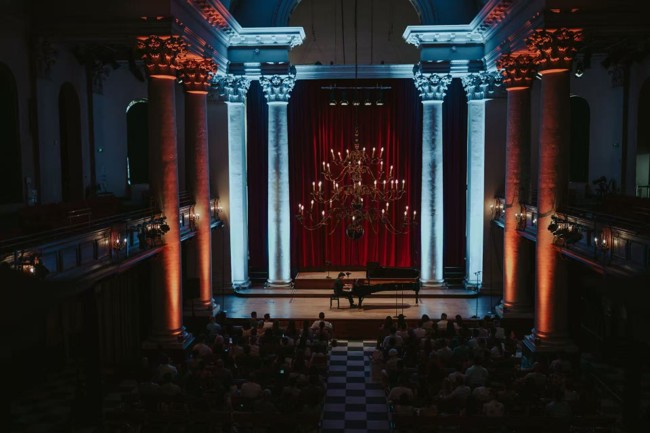

Zeju Fan’s London solo recital debut revealed a real rhythmic instinct and an ear for layered textures, strongest in Ligeti and Liszt, though bass definition and cautious transitions repeatedly interrupted the line.
This review is based on the complete video recording of the recital; the reviewer was not present in the hall.
Zeju Fan did not make life easy for himself. Beethoven’s ‘Waldstein’ Sonata, Berg’s Piano Sonata Op. 1 and two Ligeti pieces formed a substantial first half before Liszt’s B minor Sonata after the interval. The sequence made sense: each work asks a pianist to hear through several layers and keep the music moving when the texture turns awkward. Fan graduated from the Royal Academy of Music in 2026, where he studied with William Fong, after The Purcell School and Beijing’s Central Conservatory of Music.
The opening of the ‘Waldstein’ was almost matter-of-fact: quiet repeated chords, a steady pulse and no attempt to make them grander than they are. The restraint was welcome. Staccato figures stayed distinct, and an upper melody rose clearly above the middle-register triplets without being pressed forward. The rapid broken octaves ran evenly.
Lower down, the picture blurred. As the texture thickened, the lower triplets lost pitch definition and the bass registered as weight rather than moving harmony. A brief rush through a fast modulating passage came and went. The slowing before the coda was harder to ignore: by then Beethoven had done the accumulating, and the player needed only trust it. Fan took care where inevitability was wanted. The final pages recovered their drive and finished decisively, though recovery is not continuity.
The Introduzione suited him. He let it breathe, the low chords supporting rather than covering the upper line. A forte outburst rose naturally from the quiet arpeggiated writing and was allowed to subside. He carried the same patience into the Rondo, whose theme arrived lightly over a delicate accompaniment.
The finale’s wide arpeggiated leaps landed securely without disturbing the pulse. But the old problem returned in the thickest low broken chords, where inner detail disappeared, and small hesitations crept in before the return and again on the way to the coda. The Prestissimo coda was freer. Once Fan had the quicker tempo, he held it: the treble trills stayed even, the melody stayed present and the final scales were controlled. A convincing finish, even if the route there had loosened once or twice. Bruce Liu’s July Verbier account of the sonata was almost the same length, but lighter articulation made the finale feel more continuous.
The Berg was the most revealing performance before the interval. Its deliberate opening tempo could easily have sat still; it did not. Fan sustained the melodic line through the chromatic rise, and middle-register counter-lines remained audible as the writing thickened. Heavy chordal fragments and lighter material had distinct characters, while detached bass commentary registered beneath softer chords. One long crescendo gathered urgency without burying the line.
Later, low bass octaves masked an inner voice, and pedalling near the close smudged harmonic changes in the lower-middle register. In Berg, that matters immediately: the harmony does not wait for the ear to supply what has gone missing. More troubling was the pronounced rubato before a structural return. Until then, the performance had maintained a continuous line; here it separated into expressive moments. The wide chromatic leaps were secure, and the final quiet chord was given time to settle, but the interruption stayed in the ear.
Ligeti’s Étude No. 10, ‘Der Zauberlehrling’, was the most finished performance of the first half. The fast pulse was present at once and never sounded as though Fan were checking it. Upper-register articulation stayed crisp, lower accents told clearly underneath, and displaced accents kept their place. The descent into the bass lost no momentum, nor did the final sweep and abrupt ending. Only the crescendo came in stages rather than as a single continuous rise.
No. 7 of Musica ricercata exposed a different kind of control. Its ostinato was stable and fluid, the cantabile melody floating above it as a genuinely separate part. Fan kept the pulse through the move into a higher register, and the rapid ornaments came through clearly. During the crescendo, individual notes in the ostinato began to jump out and compete with the tune; when the music moved lower again, its definition briefly softened. Nothing fell apart. The balance simply became less natural.
The Liszt Sonata enlarged habits heard earlier. Fan spaced the opening pauses carefully before the fast material arrived with crisp attacks and real energy. Bass motion and scalar decoration were clean and rhythmically stable, and dense writing kept moving under pressure. More revealing was what happened between the large events. His broadening into quieter chordal resolutions remained proportionate; the move into the central slow span was carefully graded, and its climax settled without an abrupt break.
Inside that slow span, Fan shaped a delicate upper line over a softer accompaniment. Heavy chordal and bass attacks interrupted it, then receded, while the treble decoration kept its outline. This was Fan at his best: not making every strand equally important, but keeping each one in view. The fugue began crisply and with less pedal than the Berg. As the texture filled out, successive entries remained independently audible. This was the sternest test of his ear for separate lines, and it held.
The late double octaves were secure overall, aside from what sounded like isolated split notes. At the end, the quiet chords were balanced and given time to decay. There was no encore.
Fan has a genuine rhythmic instinct. When he trusts a pulse, he can sustain it through difficult writing without making the effort obvious. He listens in layers, too: melodies remain afloat above figuration, and inner parts speak when the keyboard is busy.
The recurring bass problem cannot be put down to one passage or composer. Too much weight, pedal or both repeatedly cost definition. Long crescendos were not always smoothly graded, and small checks before formal turning points became a recognisable habit. None of this cancelled the recital’s best playing. It did make the achievement uneven, a more useful conclusion than declaring the debut either a triumph or a promise.
The pulse is usually there. He does not always trust it.
Performance details
Zeju Fan, piano
Smith Square Hall (formerly St John’s Smith Square), London
26 June 2026
Ticketed public solo recital; sold out
The interval was omitted from the edit
Programme
Ludwig van Beethoven — Piano Sonata No. 21 in C major, Op. 53, ‘Waldstein’
Alban Berg — Piano Sonata, Op. 1
György Ligeti — Étude No. 10, ‘Der Zauberlehrling’
György Ligeti — Musica ricercata: VII. Cantabile, molto legato
Interval
Franz Liszt — Piano Sonata in B minor, S.178
Reviewer
Wang Jingfeng holds a Master’s degree from the Shanghai Conservatory of Music and is a senior music educator and researcher specialising in music pedagogy. His research interests include music appreciation, innovative thinking in music education, interdisciplinary learning, and instructional design.
He has published academic papers including The Application of Music Games in Classroom Music Teaching, Stimulating Innovative Thinking in Music Education, and Music Classroom Practice from the Perspective of Interdisciplinary Integration. He has also led municipal-level key research projects on backward design for music appreciation and the integration of learning and thinking in music education.