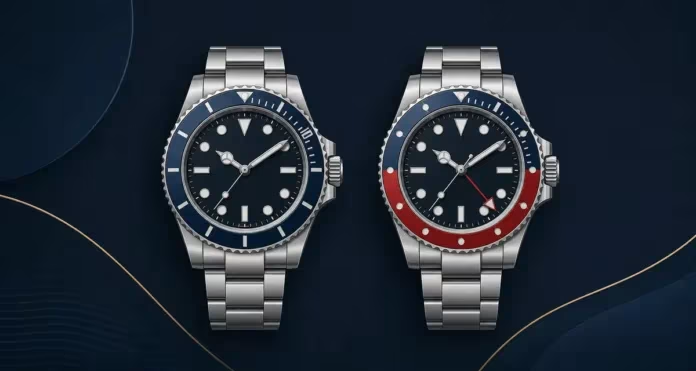

Every Rolex conversation eventually lands here. Submariner or GMT-Master II, and suddenly everyone in the room has an opinion, usually a strong one, usually delivered with the confidence of someone who’s clearly thought about this far more than is strictly healthy. Fair enough, honestly. These are two of Rolex’s most iconic tool watches, and picking between them isn’t as obvious as the price tags might suggest.
Same DNA, Genuinely Different Jobs
Both watches share Rolex’s Oyster case architecture, both wear a rotating bezel, both were built originally for people doing actual work rather than admiring their wrist in a mirror. But that’s where the similarities start thinning out. The Submariner was built for divers, pure and simple, a tool designed to track elapsed time underwater with zero fuss. The GMT-Master II was built for pilots crossing time zones, tracking two, sometimes effectively three time zones at once via that distinctive 24-hour bezel.
The Submariner: Simplicity as a Feature, Not a Limitation
There’s something almost stubborn about the Submariner’s design philosophy. It hasn’t needed to reinvent itself because the original brief- tell the time, survive the ocean, look good doing it – never really needed improving. The unidirectional rotating bezel, the thick sapphire crystal, the robust case – all of it in service of one job done extremely well. It’s the watch equivalent of a perfectly worn leather jacket; it doesn’t need updating because the fundamentals were right from the start.
The GMT-Master II: Solving a Problem the Submariner Never Had
Frequent flyers and pilots needed something the Submariner simply wasn’t built for, tracking multiple time zones without doing mental arithmetic at 3 am in an unfamiliar hotel room. The GMT-Master II’s 24-hour hand and bicolour bezel solve exactly this, elegantly, and it’s become something of a status symbol in its own right thanks to references like the Pepsi, the Batman, and the Batgirl, each named for their distinctive bezel colourways.
- Submariner: built for depth, simplicity, and rugged everyday durability
- GMT-Master II: built for travel, dual time zone tracking, and a bolder visual presence
- Submariner tends to suit a cleaner, more understated everyday rotation
- GMT-Master II tends to suit those wanting a bit more colour and visual story on the wrist
Which One Actually Fits Your Life?
Here’s the honest question worth asking before either watch: do you actually travel across time zones often enough to use a GMT function, or would it just sit there as a cool party trick you mention once and never touch again? If you’re a genuine frequent flyer, the GMT complication earns its keep daily. If your travel is mostly domestic, or infrequent, the Submariner’s simplicity might serve you better without paying for a complication you’ll rarely engage with properly.
Resale and Waitlists: Both Are a Circus, Differently
Rolex allocation remains one of the strangest corners of the luxury market; retail price bears almost no relationship to what these watches actually trade for once they leave an authorised dealer. Certain GMT-Master II references, the Pepsi and Batgirl especially, have commanded serious premiums over retail for years. Submariners hold value remarkably well too, though the gap between retail and resale tends to run a bit less feverish than the GMT-Master II’s hottest colourways.
Diving Into the Details That Actually Matter
It’s worth getting genuinely specific before deciding, since small spec differences change daily wearability more than people expect. The Submariner Date adds a cyclops magnifier over the date window, which some people love and others find visually distracting. The GMT-Master II’s bezel material, ceramic on modern references, resists fading and scratching far better than older aluminium versions, which matters if you’re planning on wearing this thing daily for the next decade rather than keeping it in a safe.
Steel or Two-Tone? Another Layer to the Decision
Both watches come in variations beyond the classic steel sports model: two-tone, full gold, platinum on certain GMT references. This adds another axis to the decision entirely. A two-tone Submariner reads differently on the wrist to a stainless one, more formal, arguably a touch flashier. The same logic applies to the GMT-Master II’s gold and steel combinations. Worth trying multiple variations before assuming the base steel model is automatically the right call for your taste.
Current Market Thinking on Both
We covered the broader question of whether buying into Rolex at all still makes sense in 2026, specifically discussing the GMT-Master II Batgirl and where the current market sits, in our piece on whether it’s worth buying a Rolex watch in 2026, which is worth a read if you’re trying to figure out whether now’s a smart time to buy either of these references, or whether patience might serve you better.
Servicing and Long-Term Ownership
Both watches are built to last generations with proper care, and Rolex’s in-house servicing network is genuinely excellent globally. That said, GMT complications carry marginally more moving parts, which occasionally means slightly higher servicing complexity down the track. Not a dealbreaker by any stretch, just worth knowing going in rather than being surprised by it a decade from now.
So Which Should You Actually Buy?
If daily simplicity, proven design, and understated confidence are what you’re after, the Submariner rarely disappoints. If you genuinely value the GMT function, or you’re drawn to the bolder visual story those bicolour bezels tell, the GMT-Master II earns its premium. Neither choice is wrong, and honestly, plenty of serious collectors eventually own both. Browse the Rolex selection to compare both in person before locking in your decision, since photos genuinely undersell how different these two watches feel on the wrist.
What About Buying Both Eventually?
It’s worth mentioning plainly: plenty of collectors don’t actually choose between these two forever, they just choose which one comes first. A Submariner as the everyday, reliable anchor piece, a GMT-Master II added later for travel and a bit more visual flair. There’s no rule saying this has to be a single, permanent decision made once and never revisited.
A Note on Sizing and Wearability
Both watches sit in a similar case size range these days, generally 40 to 41mm depending on the specific reference, which suits most wrist sizes comfortably. The GMT-Master II’s bezel adds a touch more visual weight and colour to the overall look, while the Submariner keeps things cleaner and more monochrome. Try both on with the exact bracelet configuration you’d actually wear daily before assuming spec sheets alone tell the full story.
The Bottom Line
This isn’t really a question of which watch is better, because both are exceptional at the specific job they were built to do. It’s a question of which job actually matches your life. Answer that honestly, and the rest of the decision mostly takes care of itself.