


Zuko Sian is a Dutch–South African artist whose music blends jazz, hip-hop, and soul into raw, cinematic storytelling. Born in Amsterdam, she left business school to pursue music with nothing but a mic and GarageBand. After early demos caught the attention of industry executives at ADE Beats, she joined the Herman Brood Academie and soon began collaborating with Grammy-winning producers including Sam Barsh (Kanye West, Kendrick Lamar, Doja Cat), Jordan Ware (Alicia Keys, Justin Bieber, Brent Faiyaz), and Tim Kellet (Simply Red). Her work is rooted in honesty and female empowerment, exploring themes of family, resilience, and identity. As the creative director of her own visuals, Zuko crafts music videos that blur the line between film and fine art — projects that invite you to sit still, listen deeply, and feel. With her commanding voice and visual storytelling, Zuko Sian is fast becoming one of the most arresting new voices in contemporary soul.
You left business school with just a mic and GarageBand — what was the moment you knew you had to pursue music full-time?
I chose to major in Asian Business management and had to learn Mandarin as part of the course. At the time, I constantly doubted whether I was on the right path. Unfortunately, while I was still studying, my grandmother became very ill. In her final days, even though she was unresponsive, I felt she could still hear me. So I would sit beside her bed and sing to her. When she passed, something in me shifted. A light turned on. My grandmother had been a member of her local choir in the north of the Netherlands. I thought about her life as a woman, and how she must have dreamed of pursuing so many things — yet, being a woman in the early 1900s, she wasn’t even allowed to open her own bank account. The week after her funeral, I dropped out of business school and bought a microphone online. I had absolutely no clue what I was doing, but I knew I had to follow the path she never had the chance to.
Your music blends jazz, hip-hop, and soul. How do you decide which genres or influences to bring into each track?
A lot of the time, melodies land in my head. Other times, I might hear a song I love in a movie or become hyper-fixated on a new instrument. After leaving business school, I went on to study music and majored in Hip-Hop, and I do feel that those sounds have influenced me heavily. I also draw a lot of inspiration from everyday life. Sometimes I have to be careful that things don’t get too “August Rush” in my production, because my phone is full of random noises I’ve recorded on the street.
Many of your songs explore honesty and female empowerment. How do personal experiences shape your songwriting?
In my music, I definitely draw from my own personal experiences, but I’m also heavily influenced by other people’s stories. Honesty is always at the centre of my songwriting. I never want listeners to feel like they’re standing outside a house, looking through the window while I have dinner. I want them to feel as if they’re sitting at the dinner table with me, sharing a home-cooked meal and a glass of red wine, while I update them on the latest events in my life.
You’ve worked with Grammy-winning producers like Sam Barsh and Jordan Ware. How have those collaborations shaped your sound?
I’ve been really fortunate to work with established industry professionals so early in my career. Collaborating with Sam Barsh, and later with Jordan Waré, was incredibly inspiring. Those sessions not only enriched my sound — because I was learning constantly — but they also gave me a huge boost in confidence. Since no one in my family comes from a musical background, it was motivating to see what they had achieved and to realise that a career like theirs wasn’t out of reach for someone like me.
You’re involved in the creative direction of your visuals. How does the process of making a music video compare to writing a song?
For me, the process is actually quite similar. When I write a song, I approach it almost the same way I’d write a script — I start with the core idea, and then I begin building around it. With a music video, there are so many details to consider: camera angles, lenses, styling, set design, lighting. Music has its own version of that — melodies, lyrics, production, mixing, mastering. Every element carries its own weight, and they’re all equally important. Usually, everything starts to come together like a mosaic once I’ve settled on the overall theme. From there, both the visuals and the music naturally fall into place.
“Spill A Little Tea” was written in just fifteen minutes. What inspired the immediacy of this song?
I use music as a place to store my emotions.My songs are a museum of thoughts and feelings. I don’t always want to write but In order for me to move on I have to let it out. I think that is why it came out so quickly. I didn’t want it to be bottled up.
The lyrics deal with truth-telling after personal conflict. Was there a particular moment or conversation that sparked the song?
I remember having this moment where I found myself thinking deeply about the patterns I see in society — especially around how we communicate in our friendships and relationships. I started noticing a connection between our willingness to have honest, open conversations and the fast-paced, surface-level nature of social media. It feels like the way we interact online has started to shape how we show up with the people closest to us.
How do you balance vulnerability with strength in your music, especially in tracks like this one?
I believe vulnerability is strength. Songwriting is inherently vulnerable, the way I write is quite direct, it took me a while to feel comfortable to write something directly. I remember in the beginning I would write things like “poppies crack through the side of the pavement waiting for the light to hit the petals” now I would probably write “ you hurt me but I’m going to get through”. Both mean that I have been hurt but I have become more comfortable not to hide behind my poetry.
Your signature vocal tone has been described as “Burgundy red.” How do you maintain that richness while conveying raw emotion?
To maintain that richness while still showing raw emotion, I focus on grounding myself physically before I sing. I keep my breath low, my body relaxed, and I let the emotion sit on top of the tone rather than overwhelm it. For me, the richness comes from control, but the emotion comes from letting myself be vulnerable in the moment. When I connect to the story behind the song, the tone naturally colours itself without me having to force anything.”
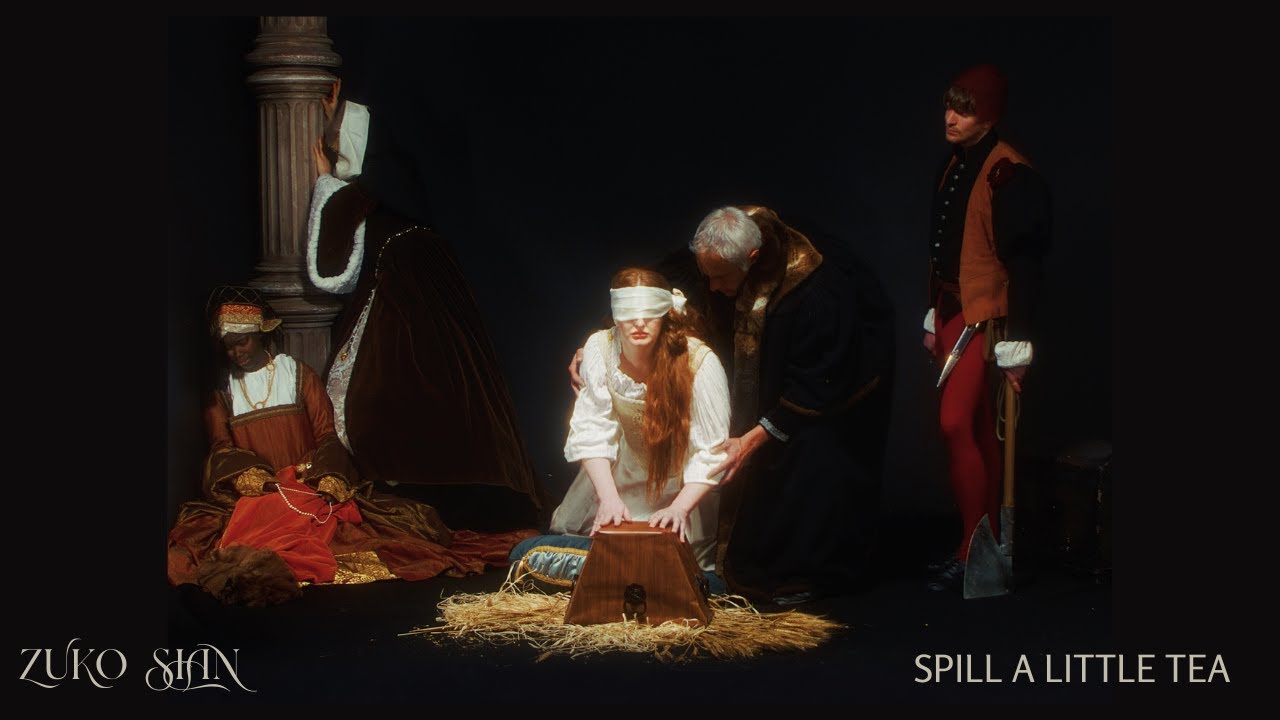
The video is inspired by Paul Delaroche’s The Execution of Lady Jane Grey. What drew you to this historical painting?
When I first came to London I decided to go to the National Portrait Gallery, when I saw the painting I was completely mesmerised. When I visited again some time later with Jade Laurelle who directed my music video we sat in-front of the painting looking at her for what must have been an hour. What drew me in most was the story and the sadness that I felt before I ever knew what her story was about.
You wore Helena Bonham Carter’s gown from the 1986 Lady Jane film. How did it feel to step into that historical and cinematic context?
It was really amazing, I grew up watching all her movies. When I went to visit the costume company that sourced the period pieces to try on the dress I had no idea. The dress I initially tried did not feel right, when the lady came back with a different option I saw her name written on the label, it was pure luck, or maybe it was meant to be.
You helped craft elements of the set yourself. How important is hands-on involvement for bringing your vision to life?
As an independent artist it is very important for me to be involved with everything that happens creatively surrounding my music. I have a great appreciation for cinematography. The details of this painting are very specific so when we could not find some exact items I decided to make them myself. It is my hope to invite the listener into my world and to feel welcome. There are a lot of details that matter when it comes to storytelling and world building.
How do you want viewers to interpret the video — as history, a metaphor, or something else entirely?
When viewers see the music video I hope to inspire them. And mostly to highlight the fact that just because women were executed and belittled in the past doesn’t mean it has to continue like that going forward. There is a twist in the music video contrary to the painting and I hope people are also entertained as there are also humorous elements to this music video.
If “Spill A Little Tea” were a color, a drink, and a movie, what would each be and why?
If Spill A Little Tea were a color it would be pearl white, just like Jane’s dress, I feel like the song represents boundaries, once you set boundaries for yourself and in your friendships you can open up without being afraid someone might steal your pearl. If it were a drink I would say a smoked honey bourbon as this drink is both felt in the chest and head and writing this song felt like that. And if it were a movie it would be The Love Witch. Like the main character, I was trying to understand why love and loyalty can twist something darker. It’s about the illusion of love and friendship, and what happens when those illusions break.
What’s one surprising thing you learned about yourself during the making of this song and video that fans might not expect?
I learnt that I still have love for the people I had to walk away from in my life. It surprised me that moving on didn’t mean I stopped caring, it just meant I started caring about myself more.




