

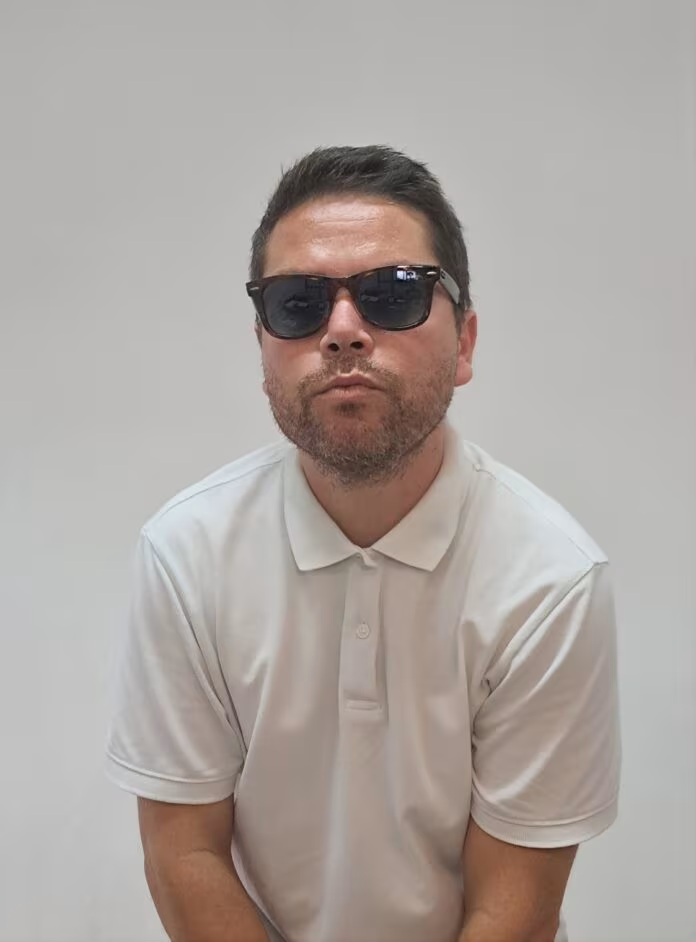

Italian singer-songwriter Claudio Conti is entering a new chapter with Kierkegaarden, his forthcoming fourth solo album and first full-length project written and recorded entirely in Italian. The album follows a long musical journey that has taken Conti through several bands, solo records and different cities, while maintaining a deep connection to baroque pop, classic songwriting and the melancholy of memory.
The first taste of Kierkegaarden arrived with “Verità”, a song built around the idea of those seemingly insignificant “sliding doors” moments that can quietly alter the course of a life. With its combination of acoustic guitar, English horn and harpsichord, the track captures the album’s nostalgic, richly textured atmosphere while reflecting on missed possibilities and the desire to rewrite the past.
Ahead of Kierkegaarden’s November 11 release, we caught up with Claudio Conti to talk about “Verità”, writing in Italian, the experiences that shaped the album, his musical influences and what comes next.

“Verità” is built around the idea of those ‘sliding doors’ moments that can quietly change the course of a life. Was there a particular experience or thought that first sparked the song?
Absolutely. Not being able to win someone’s heart. Sometimes you meet the right person at the wrong time.
Your music has always been shaped by memory, place and a certain sense of melancholy. What is it about looking back — and the way we remember things — that continues to draw you in as a songwriter?
The present and the future are the children of the past. The past is my father and my mother. What would be the point of leaving them out?
You’ve been making music since the early 2000s, moving through projects like Handmaids Skim The Marble and Magic Salad before developing your solo work. Looking back at that journey, how do you feel those earlier chapters have shaped the artist you are today?
I’ve learned what I shouldn’t repeat, both in the writing process and during pre-production and studio recording. With experience, you learn to make more strategic choices and to filter things out.
Obviously, those earlier chapters are also connected to all the water that has flowed through the mill of my own life.
Kierkegaarden is your first full-length project written and recorded entirely in Italian, after years of writing in English. What made this feel like the right moment to return to your native language, and did it change the way you approached the songs?
Pure curiosity and experimentation. There are so many singers and songwriters I’ve listened to and who have influenced me, above all Battisti, Endrigo, Bindi, Tenco and Graziani.
I felt the need to release an album in my native language. It was something I had wanted to do for a long time, and it felt like the right moment.
That said, for the time being it represents only a brief chapter. I’ve already written more than half of another album, and of course it’s in English.
English remains, and will remain, my main language of expression. In music, I find it more universal and direct.
But it was a very interesting experiment.
The arrangements on “Verità” bring together acoustic guitar, English horn, harpsichord, bass and drums. How did you arrive at that particular combination of sounds, and what did those instruments allow you to express that a more straightforward arrangement might not?
Because I’ve always imagined the melancholy of baroque pop as the perfect vehicle for these lyrics and this melody. I really can’t imagine the song without harpsichord and English horn.
You wrote around 50 songs before deciding which ones would make it onto Kierkegaarden. What were you looking for when narrowing that material down, and did the songs themselves ultimately dictate the shape of the album?
Quite simply, I had to choose the songs that best represented the period in which the album was made.
I had health problems for at least two years, and that phase inevitably shaped both the album itself and the choice of songs.
You’ve cited artists such as Gene Clark, Ray Davies, Bill Fay and Andy Partridge, alongside baroque pop, jangle pop and the psychedelic songwriting of 1960s LA and San Francisco. What is it about that era and those songwriters that still feels relevant to you now?
The magic.
Those people were immensely talented magicians living in an era when you could touch something and turn it into gold.
When it comes to my influences, I’m thinking especially of Los Angeles in the second half of the 1960s.
It was an unrepeatable concentration of talent, money, freedom and recklessness, a perfect ecosystem that existed for only a few years. What made it extraordinary was precisely the alchemy between elements that would normally tend to cancel each other out.
You had the record labels and recording studios, arrangers, engineers and phenomenal session musicians.
So this was certainly not music being made with limited resources. At the same time, however, the industry had not yet fully worked out the formula for taming the new generations.
And perhaps that is the key point: nobody knew exactly what was going to work.
I was lucky enough to live in L.A. for about a year, and if you wander around those hills, I swear you can still feel the magic of artists who once lived there, people like Arthur Lee or Gene Clark.
With Kierkegaarden arriving in November, what are you hoping to explore next — whether that’s with the album, live shows, new music or other creative projects?
I hope the promotion goes extremely well. Unfortunately, since I’m not currently signed to a record label, I can’t guarantee a promotional tour.
I hope I’ll be able to play some dates in England and elsewhere in Europe, perhaps some festival slots or even opening-act opportunities. Who knows? We’ll see. At the moment it’s still too early to know.
As I mentioned earlier, I’m writing a new album, and I’ve also returned to painting after taking a break from it.
I’d also like to put together another retrospective exhibition in a gallery, although there is absolutely no deadline for that at the moment.
More than anything, though, I hope Kierkegaarden receives the attention it deserves, both in the UK and Europe and in America.




