

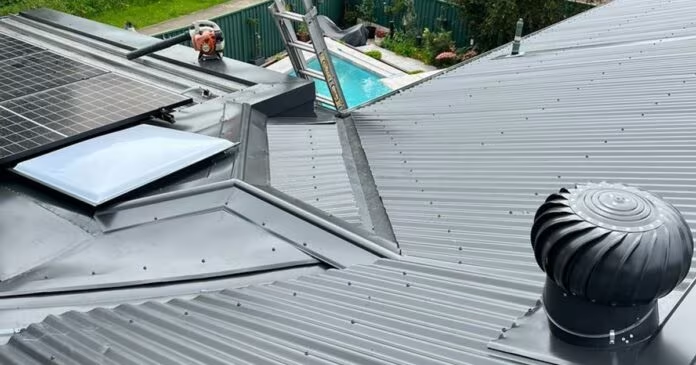

Most Australian homes built between the 1950s and the 1990s have a tiled roof, and a large share of those roofs are now reaching the age where the question stops being how to patch them and becomes what to replace them with. The two realistic answers are new tiles or Colorbond steel. Both are good roofs. They suit different houses, different budgets and different owners, and the decision is easier once you know what each one actually changes.
Weight, and what it means for the house
A tiled roof weighs roughly four to five times what a Colorbond roof does. That sounds like a point for steel, and it often is, but the direction matters. A house framed for tiles can carry Colorbond without any structural change, because the frame was built for the heavier load. The reverse is not true. A house that has always had a metal roof usually cannot take tiles without new framing, which is a structural job with an engineer and council involved. So if you are on tiles now, both options are open to you. If you are on metal, you are almost certainly staying on metal.
Pitch
Tiles need a reasonable slope to shed water: fifteen degrees is the usual minimum, and between fifteen and about twenty the manufacturers require sarking underneath because wind pushes rain up under the laps. Corrugated Colorbond works down to five degrees, and the concealed-fix profiles lower again. A tiled roof at the classic Australian pitch of 22.5 degrees can take either. A low skillion extension, or a roof that has been flattened out over a rear addition, is steel territory, whatever the rest of the house is wearing.
Heat and noise
This is where the folklore lives. Metal roofs are not automatically hotter, and they are not automatically noisier, but both depend on what goes underneath. A Colorbond roof over a proper insulation blanket is quiet in rain and no hotter in the roof space than tile. A Colorbond roof screwed straight onto battens with nothing under it is the roof people remember from the shed. Colour matters on both materials; a dark roof runs warmer than a light one, and in New South Wales the roof colour feeds into the BASIX assessment for new work, so a dark choice can mean more ceiling insulation to compensate. Ask the roofer what insulation is in the quote, not just what is on top.
Lifespan and maintenance
Terracotta tiles last longest of all, often seventy years and more, but the bedding and pointing on the ridges needs redoing every fifteen to twenty years and individual tiles crack under foot traffic and hail. Concrete tiles go porous and fade over thirty to forty years and are usually restored (cleaned, repointed, coated) at least once in that life. Colorbond carries a long warranty and needs no pointing, but near the coast the fixings and flashings corrode first and need attention long before the sheets do, and within a few hundred metres of surf the marine grade of steel is the right specification rather than an upgrade.
Cost
Supply and install per square metre of roof surface, in Sydney in 2026, Colorbond typically starts around $170, concrete tile around $180 and terracotta around $200, with the old roof stripped, new sarking laid and standard flashings included. On a 200 square metre roof that puts Colorbond around $37,000 to $45,000 and terracotta around $46,000 to $55,000; a fuller breakdown of what a roof replacement costs in Sydney sits on our site. Two things move those numbers more than the material does: access, especially two storeys, and pitch, because anything much over thirty degrees needs more safety setup and often scaffold. Regional pricing runs lower than Sydney for labour and similar for materials.
Look and resale
A Federation cottage or an inter-war bungalow in a street of terracotta roofs will usually sell better with terracotta back on it, and some heritage areas will not permit a change of material at all. A 1970s brick veneer or a rendered home from any era generally looks more current in Colorbond, particularly the dark greys, and buyers in that segment read a new steel roof as a low-maintenance asset. Match the street before you match a magazine.
The honest question to ask
Before choosing between the two, ask whether the roof needs replacing at all. A leak in one section, cracked bedding on the ridges, or a roof that has simply faded are all repair or restoration jobs at a fraction of the price, and a roofer who inspects first will tell you which one you have. Most tiled roofs we are called to look at need work on a section, not the whole roof.
If the answer is a genuine replacement and the house is tiled now, both options are open. Get the quote in writing for each, with the same scope, and compare the insulation, the flashings and the warranty rather than just the bottom line. A worked example of what a Colorbond re-roof includes, and what changes the price, is a useful benchmark even if you end up choosing tiles.
About the author
Joshua Liptak runs Aussie Roof Repairs, a licensed Sydney roofing business (NSW Licence 488966C) working across the Sutherland Shire, St George and greater Sydney.




