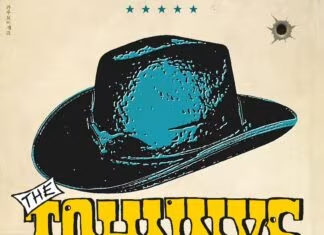
Der Oscar Effekt has built a world where tradition, memory and modern identity all share the same fire. After three albums in three years, he returns with three stone fireside, vol. 1, his most intimate work yet — a project shaped by late-night studio sessions, multilingual storytelling, and the ancestral warmth of the fireside that raised him. Speaking with a rare blend of honesty and intention, Der Oscar Effekt invites us into the spaces between silence and expression, heritage and evolution, and the inner fire that keeps his art — and his spirit — moving.
- You’ve said “Fool” comes from a place where silence speaks louder than reaction. What’s something you learned about your own silence during that period? Something you didn’t realize until you wrote the song?
I realised silence is a form of strength. Instead of reacting on impulse, taking that step back to understand what you feel is already a type of healing.
What surprised me when I wrote “Fool” was recognising that some emotions I thought were long gone were still there. I didn’t sit down intending to write that track, it just happened one night in my home studio. And once the song was finished, everything clicked. I finally understood where the emotion came from.
- The three-stone fireside isn’t just a symbol of home, it’s literally a technology of survival, balance, and nourishment. Which of those three “stones” do you feel your life rests on today? And which one feels unstable?
Today, I’d say my life rests on balance.
I’m grateful to be past the survival stage, and nourishment, in the emotional and creative sense is something I give a lot of importance to. But balance is where I’m really standing today: managing family, a career, and creating music consistently. It’s the stone I protect the most because it keeps me grounded.
- Most of the beats on the album were handcrafted for you in Cameroon. When you hear those rhythms in Germany (far from home) what emotions surface first: nostalgia, responsibility, or distance?
Honestly, it’s all three.
Nostalgia, because certain sounds instantly pull me back to childhood memories.
Responsibility, because part of my sound is rooted in my culture, and I feel the duty to honour it, reinterpret it, and carry it forward.
And distance, since music becomes that bridge between home and where I am now. It keeps me connected.
- Your sound sits between tradition and modernity, but not in a “fusion for aesthetics” way. What’s one tradition you refuse to modernize in your music and one modern influence you refuse to apologize for?
A tradition I’ll never change is the use of multiple languages. English, Pidgin, French, Camfranglais, that’s how I grew up, how I speak with friends and family. It’s part of my identity.
The modern influence I don’t apologise for is perhaps refusing to be boxed in.
If today I feel like rapping with a hip-hop flow, that’s what I’ll do. Tomorrow it could be a mellow vibe, afrobeats, makossa, or even kizomba. My sound shifts with my emotions and that freedom is important to me.
- There’s a recurring theme in your work of belonging to two worlds: snow and dust, Europe and Africa, structure and intuition. Do you ever feel like one world listens to you more than the other?
Both worlds listen but the way they respond feels different.
Africa precisely Cameroon raised me. Germany & Europe contributed in shaping me into the man I am now. So the feedback I receive from both sides holds a different emotional weight. But they both give me a listening ear.
- “Fool” is about being underestimated. Do you think there’s power in letting people misunderstand you or does it cost you something every time?
There’s power in being underestimated.
Carl Jung said, “The fool is the precursor to the savior.”
People can misunderstand and underestimate you all they want, as long as you know who you are and what you’re capable of, their perspective loses importance. It has never stopped me, be it in my personal, professional or creative pursuit.
- When you’re writing songs after your 9-to-5, you’re creating art in the cracks of the day. How has making music under limitation shaped your creative identity compared to having ‘ideal’ conditions?
I don’t see making music while having a 9-to-5 as a limitation. With three albums in three years (Kryptonite, 2023; Neige et poussière, 2024; and three stone fireside, vol. 1, 2025), over 60 songs released since 2018, a hand full of them recorded in my home studio… it shows that creativity doesn’t wait for perfect conditions and that it is possible to create time for the things you are passionate about. Plus, there is no such thing as „ideal“ conditions, that’s a comfortable blanket used as an excuse to cover oneself from not taking action.
#9to5isnoexcuse isn’t just a hashtag I created, it’s genuinely my lifestyle.
- three stone fireside, vol. 1 feels like a return to source. If this project is you coming home, what are you bringing back with you that the younger you didn’t have?
I’m bringing back the love for music, the kind I didn’t even know I had growing up.
As a kid, I didn’t make music; my relationship with music was expressed via dancing. Only later, when already in Germany did I realise I had a gift, that I could shape melodies, create vibes, write lyrics and make music. After years of constantly making and releasing songs, three stone fireside, vol.1, at least part of it feels like a recognition of and appreciation for the sounds I grew up on and the fire that shaped me.
- Your music often feels like you’re documenting emotional landscapes more than telling stories. When you look at this album, what landscape do you see — forest, desert, sea, or something else?
If this album were a landscape, I’d see a small village at the foot of a mountain just after sunset, and family and closest friends gathered around a steady, warm fireside.
Not a special event, not a ceremony, just that everyday moment where the people you love sit together, talk, laugh, tell old stories, or simply enjoy the silence.
That’s the atmosphere I feel when I think of this project.
But beyond the cultural image, the fireside also represents something universal: the human need for warmth, belonging, and connection.
Whether you grew up with a three-stone fireside or not, everyone knows the feeling of being held by the presence of people who make you feel safe, grounded, and understood.
The fire in that landscape isn’t just physical. It’s the inner fire that keeps you moving, keeps you grounded, and reminds you who you are when life gets cold.
- Is there a question you wish people would stop asking you, and one you wish someone would dare to ask?
I often get asked how I manage to make music consistently; recording, mixing, releasing while working a 9-to-5, going to the gym, and being present for my family.
Truth is, I don’t really know how I balance it, I just make time because I love it. I’m passionate, and I can’t stop.
A question I wish someone would dare to ask is:
“What’s your end goal with music?”
Because that answer reveals a lot about who I am and why I create.